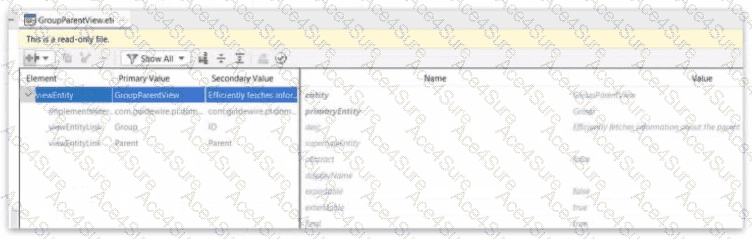
In Guidewire InsuranceSuite,ViewEntitiesare specialized entities used to optimize the performance of List Views (LVs). Instead of loading full, heavy entity objects into memory (which can cause significant overhead and "N+1 query" issues), a ViewEntity allows the developer to define a "flat" structure that only contains the specific columns needed for display.
1. Extending ViewEntities via .etx (Option C)
When you need to add a field to an existing base ViewEntity, such as GroupParentView, you must follow the standard extension architecture. Since GroupParentView is a base application object, you cannot modify its original definition file (.eti). Instead, you must create or modify an extension file, which has the.etxextension.
Because GroupType is aTypekey(a field linked to a Typelist), the correct metadata tag to use within the ViewEntity definition is<viewEntityType>. This tag maps the typekey from the underlying Group entity to a field on the GroupParentView object. By adding this to the .etx file, you ensure the change is upgrade-safe and follows Guidewire's architectural standards.
2. Performance and Best Practices
Why is Option D considered an anti-pattern? In a PCF List View, if you use the syntax GroupParentView.Group.GroupType, you are "dot-walking" from the ViewEntity back to the full Group entity. This forces the Guidewire application server to load the entire Group object for every single row in the list. If a list has 100 rows, this could result in 100 unnecessary database loads.
By properly mapping the field in theViewEntity metadata(Option C), the field is included in the initial flattened SQL query generated by the system. This allows the application to retrieve all necessary data for the list in a single, efficient database round-trip. This "Database-First" approach is a core pillar of Guidewire performance tuning and is the primary reason ViewEntities are used in the product.