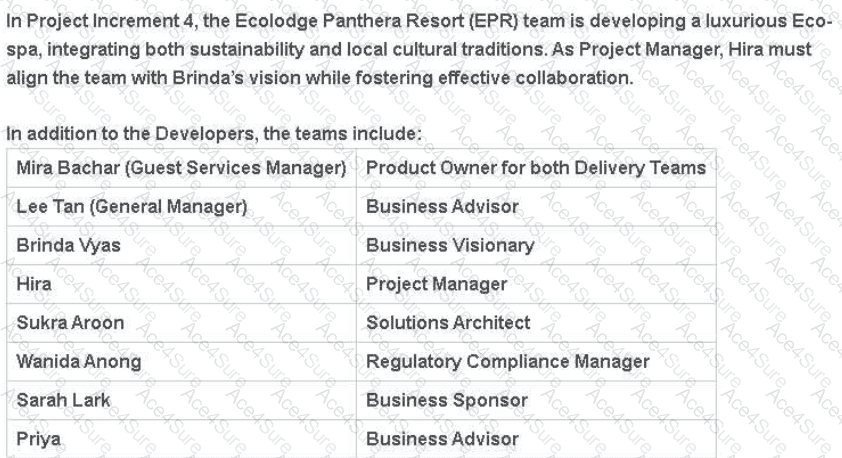
In AgilePM, a Delivery Team structure should support effective collaboration, clear focus, frequent delivery, and alignment to business needs . Hira’s proposal to split the Developers into two Delivery Teams can be justified when that structure improves communication, coordination, and commitment around a coherent area of work.
Option D is correct because it best reflects a practical AgilePM reason for organizing teams in this way. If one team concentrates on Spa Infrastructure and the other on Guest Experience / Spa Operations , each team can build stronger collaboration around a shared purpose. Team members working toward closely related outcomes often communicate more effectively, develop stronger ownership, and stay better aligned to their immediate goals. In AgilePM, this supports the principle of creating empowered teams that can focus on delivering business value.
Why the other options are incorrect from an AgilePM perspective:
A is incorrect because one Delivery Team should not dictate another team’s priorities. In AgilePM, priorities are driven by the business need and managed through appropriate roles such as the Business Visionary and especially the Product Owner / Business Ambassador-style representation of business needs , not by one team controlling another. Teams collaborate; they do not command each other.
B is incorrect because separate Delivery Teams do not eliminate the need for coordination. In this scenario, the spa infrastructure and guest experience elements are clearly connected. For example, treatment rooms, utilities, hydrotherapy capability, reservations support, and guest experience design are likely to have dependencies. AgilePM supports iterative delivery, but it also recognizes the importance of active coordination where workstreams are interdependent.
C is incorrect because although team focus is valuable, the wording suggests separation from “other skill sets” in a way that promotes silos. AgilePM favors collaborative, multi-skilled teams , not isolated specialist groups that avoid interaction. A team may have a specialization in outcome or domain, but Agile ways of working still depend on cross-functional cooperation and shared understanding.
From the case context, Hira is managing a significant initiative that combines:
construction and sustainable infrastructure,
wellness services,
guest operations,
local traditions,
compliance,
and business value delivery.
Because the work spans distinct but related domains, having two specialized Delivery Teams can make sense only if it improves communication and commitment within each area while still preserving overall coordination under shared product direction. That is exactly what Option D captures.
So, from an AgilePM viewpoint, D is the strongest supporting statement because it aligns with the idea that an effective team structure should enhance collaboration, ownership, and focus while contributing to successful incremental delivery.