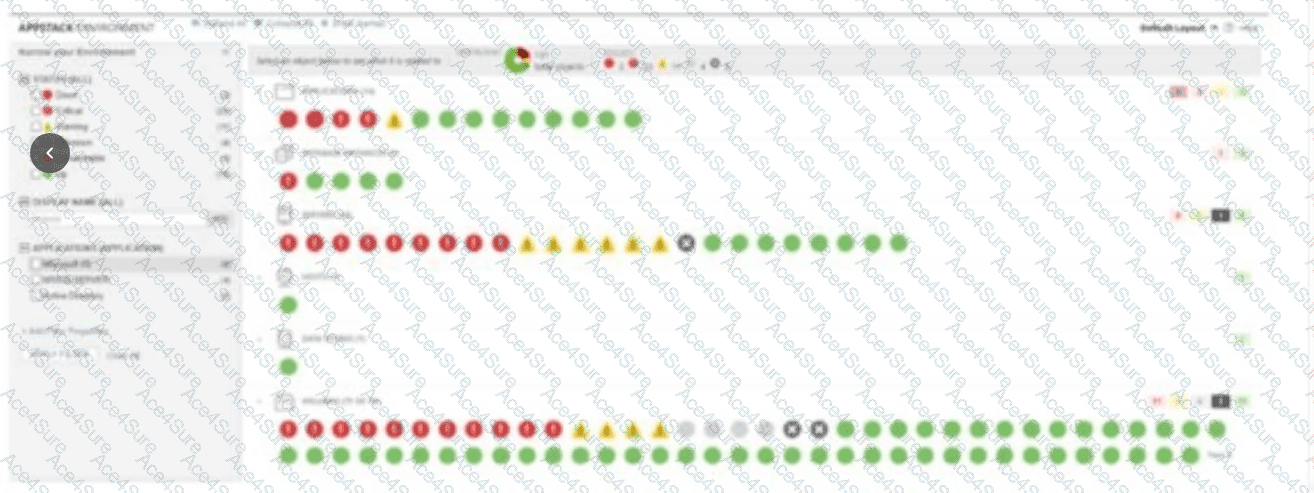
According to the SolarWinds Platform Administrator Guide for Hybrid Cloud Observability, theAppStack Environment Viewprovides an interactive, visual mapping of relationships between monitored entities such as applications, servers, and storage. In the provided image, it is evident thata filter is applied to show entities related to an application (A)because the left-hand navigation pane shows specific filters selected under the "Applications" category, and the main view displays a subset of the environment's total objects that correspond specifically to those application relationships. This filtering capability allows users to narrow down the environment to focus on the specific dependencies of a critical business service, such as Microsoft Active Directory or a SQL Server instance, which are shown as filtered groups in the sidebar.
Furthermore, it can be concluded thatthe option to hide categories with no objects is selected (B). A standard, unfiltered AppStack view typically displays every possible layer of the IT stack—including Transactions, LUNs, Pools, and Arrays—regardless of whether they contain active entities. However, in the provided view, only categories containing entities relevant to the current filter (such as Applications, Database Instances, Servers, and Volumes) are visible. This indicates that the "Hide categories with no objects" setting is active, which is a standard customization used to clean up the interface and highlight only the active parts of the dependency map.
While the view shows storage-related entities like "Volumes," this does not confirm whether theStorage Resource Monitor (SRM) is not installed (C), as basic volume data can often be collected via standard node polling. Additionally, the AppStack interface itself does not provide enough diagnostic data to verify if theuser account is given administrator access rights (D), as these visual elements are accessible to non-admin users with appropriate view permissions. Therefore, A and B are the only verified conclusions based on the visual evidence of the filtered environment.