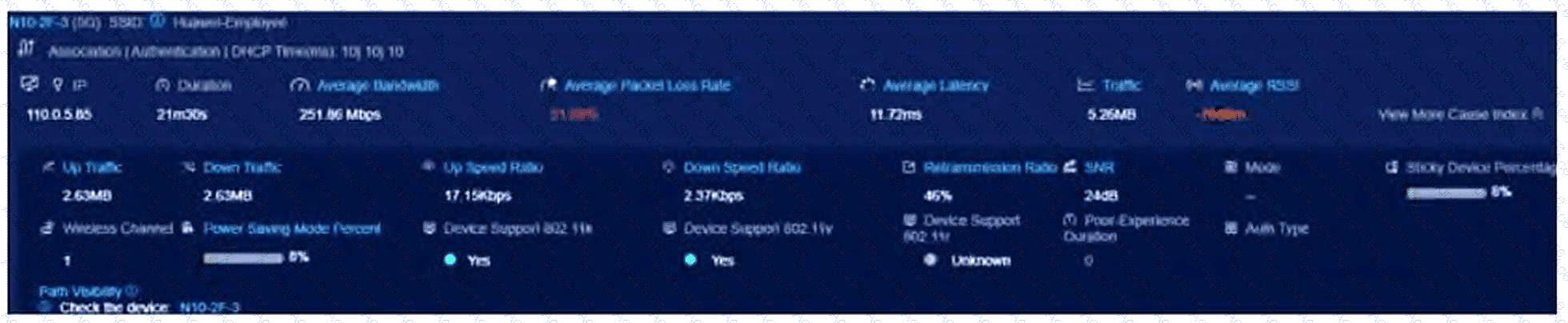
Huawei CampusInsight provides user journey analysis to identify the causes of poor wireless experience by correlating individual user metrics with network events.
The exhibit displays terminal measurements including average bandwidth, average packet loss rate, average latency, average received signal strength indicator (RSSI), and wireless protocol capabilities.
The most significant indicators are the weak RSSI measurement and elevated average packet loss rate.
Poor RSSI indicates that the station is receiving a weak wireless signal. This may result from excessive distance from the AP, physical obstacles, signal attenuation, or an unsuitable AP installation position.
Weak signal conditions can increase frame errors and retransmissions, reducing throughput and degrading the user's application experience.
Option B is incorrect because the exhibit indicates that the terminal supports IEEE 802.11r.
Option C is not established because the screenshot does not provide sufficient evidence that the terminal's hardware performance is responsible for its experience problems.
Option D is also unsupported because the displayed power-saving information does not establish a causal relationship with the observed packet loss.
Huawei's Training Material presents the same diagnostic approach, identifying low RSSI and elevated packet loss as indicators of weak-signal coverage.
Therefore, option A is the supported answer.
Training Material reference: WLAN O and M → CampusInsight → Individual Issue Analysis: Journey Analysis, PDF p. 931, slide 43.
Lab Guide reference: Lab 11 — CampusInsight O & M → Monitoring and Experience Analysis.
────────────────────────────────────────────────────────