The correct answers are A and B .
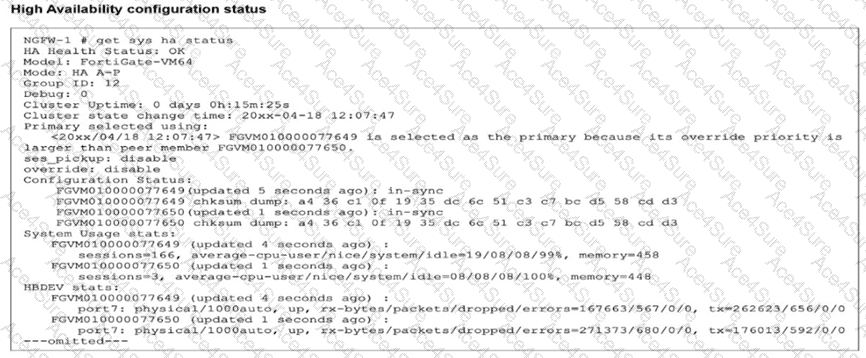
The exhibit shows:
override: disable
both members are currently in-sync
only port7 appears under HBDEV stats , so it is the active heartbeat interface
the cluster is in HA A-P mode
Why A is correct:
With override disabled , after a failover the new primary keeps that role when the old primary comes back. The FortiOS administration guide states:
“When the primary FortiGate rejoins the cluster the secondary FortiGate continues to operate as the primary FortiGate.”
So if FGVM...649 reboots and FGVM...650 becomes primary, FGVM...650 will remain primary after FGVM...649 rejoins.
Why B is correct:
The study guide states:
“When FortiGate devices configured in an HA cluster lose communication with each other on the heartbeat interface, each FortiGate assumes the role of the primary device.”
The exhibit shows only port7 as the heartbeat device in HBDEV stats
So if port7 is disconnected and heartbeat communication is lost, the cluster can enter a split-brain condition, where both units believe they are primary. The FortiOS administration guide confirms the same behavior: loss of heartbeat communication causes each member to think it is the primary
Why the other options are wrong:
C is wrong because configuration synchronization status is specifically used to detect whether secondary members remain synchronized with the primary. If members are no longer synchronized, the status changes from in-sync to out-of-sync
D is wrong because the study guide explains that during a configuration change, checksums may differ briefly while changes are copied, but it does not describe this as the secondary initiating a “synchronization reset”
So the verified answers are: A, B .