The correct answers are B and D .
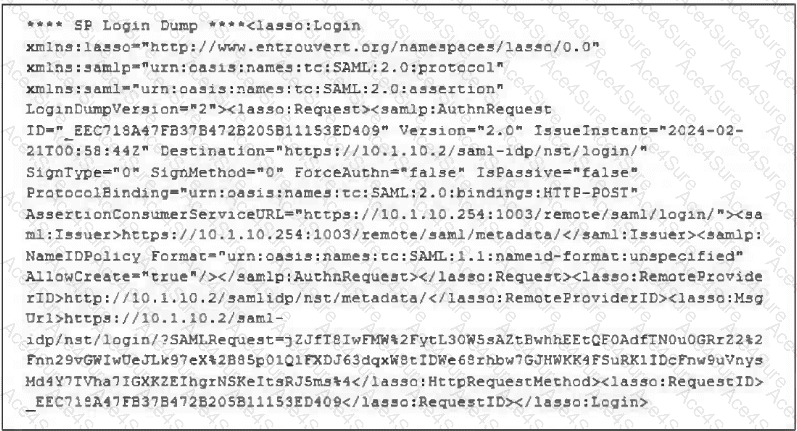
The study guide explains that in the SP Login Dump section, FortiGate is acting as the service provider (SP) , and that you should read these fields:
“The IdP SSO URL, from the setting idp-single-sign-on-url in the FortiGate configuration”
“The SP SSO URL, from the setting single-sign-on-url in the FortiGate configuration”
“The IdP Entity ID, from the setting id-entity-id in the FortiGate configuration”
“The SP Entity ID, from the setting entity-id setting in the FortiGate configuration”
In the exhibit:
Destination= " https://10.1.10.2/saml-idp/nst/login/ " → this is the IdP SSO URL
< lasso:RemoteProviderID > http://10.1.10.2/samlidp/nst/metadata/ < /lasso:RemoteProviderID > → this is the IdP Entity ID
AssertionConsumerServiceURL= " https://10.1.10.254:1003/remote/saml/login/ " → this is the SP SSO URL
< saml:Issuer > https://10.1.10.254:1003/remote/saml/metadata/ < /saml:Issuer > → this is the SP Entity ID
The same study-guide example shows this exact mapping pattern, where:
Destination points to the IdP
AssertionConsumerServiceURL and Issuer point to the SP
Therefore:
So the verified answers are: B, D .