According to the PMBOKĀ® Guide (Project Management Body of Knowledge), specifically within the Project Scope Management knowledge area and the Collect Requirements process:
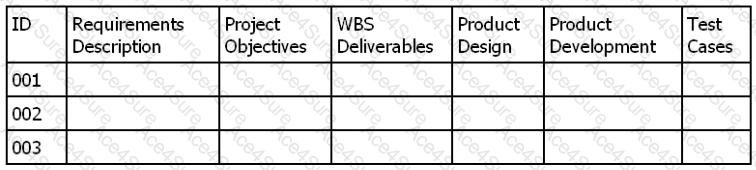
Requirements Traceability Matrix (Option D): The image provided is a textbook example of a Requirements Traceability Matrix (RTM). An RTM is a grid that links product requirements from their origin to the deliverables that satisfy them. As shown in the chart, it tracks the ID and Requirements Description through various stages of the project life cycle, including Project Objectives, WBS Deliverables, Product Design, Product Development, and Test Cases. This ensures that each requirement adds business value and that all requirements are accounted for at the end of the project.
Responsibility Assignment Matrix (RAM) / RACI Chart (Options A and C): These are tools used in Project Resource Management. They map project work packages to the individuals or groups responsible for them (Responsible, Accountable, Consulted, Informed). They do not track technical requirements or product design stages.
Work Breakdown Structure (WBS) (Option B): A WBS is a hierarchical decomposition of the total scope of work to be carried out by the project team. It is typically displayed as a tree diagram or an indented list of work packages, not a horizontal matrix tracking the development lifecycle of specific requirements.
In the PMI framework, the Requirements Traceability Matrix is essential for managing scope creep. It provides a means to track requirements throughout the project life cycle, ensuring that requirements approved in the charter and scope statement are actually delivered and tested.
CAPM PDF/Engine
Printable Format
Value of Money
100% Pass Assurance
Verified Answers
Researched by Industry Experts
Based on Real Exams Scenarios
100% Real Questions
Get 65% Discount on All Products,
Use Coupon: "ac4s65"