
GARP SCR Question Answer
Alimento Y Agricultura (AYA) is a food and agriculture conglomerate headquartered in Costa Rica with operations throughout Central America. AYA historically produced coffee, bananas, and sugar. Over the last decade, the company growing region experienced climate-related crop production challenges. The region suffered prolonged drought conditions and severe flooding events. AYA leadership may relocate existing coffee farm locations in response to these climate stressors.
Last year Costa Rica introduced mandatory climate risk reporting aligned with ISSB standards The government mandate compelled AYA to enhance its transition and physical risk assessment across the company. A newly formed sustainability governance team prioritizes the following objectives:
• Update TCFD reporting with new ISSB IFRS S2 requirements
• Initiate more comprehensive scenario analysis
• Conduct nature and water risk assessments
AYA previously reported climate risks aligned with all TCFD pillars, risk categories, and scenario analysis recommendations. Reporting includes all Scope 1 and Scope 2 emissions, reduction targets, and appointments of board officers responsible for climate risks. Scenario analysis is used to assess all banana, coffee, and sugar production climate risk exposure.
AYA uses 2°C and 4°C climate scenarios to assess company impacts from physical and transition risk. Under the 2°C scenario transition risk increases, while under the 4°C scenario water risk significantly increases.
AYA appoints an SCR certificate holder to the position of nature risk manager to advance nature-based assessments. The manager contracts with a nature risk consultancy to better understand and manage exposure to nature-related risks and impacts. The consultancy identifies crop production, water quality, and water quantity as the primary nature-based risks.
The consultancy produces the following graph to demonstrate coffee crop productivity:
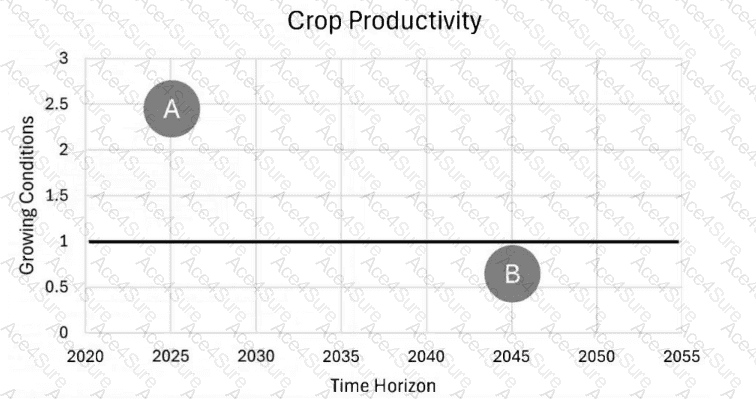
If growing conditions fall below 1, it is not economical for AYA to continue coffee production in the region. Point A indicates current growing conditions. Point B is a forecast of future conditions under a 4°C scenario, created by the consultancy model.
After identifying nature risks broadly, AYA performs a water risk assessment (WRA). The WRA assesses historical and future water withdrawal rates and identifies operational water dependencies.
Following the WRA, the company engages with existing stakeholders to adapt existing business strategy. AYA initiates a pilot project with upstream farmers to protect their land. AYA will either train or pay local farmers to plant shrubbery and buffer zones to reduce erosion and runoff of sediments, nutrients, and pathogens from local crop production and industry.
Which LEAP concept best describes Point A in the context of coffee growing conditions?
- Printable Format
- Value of Money
- 100% Pass Assurance
- Verified Answers
- Researched by Industry Experts
- Based on Real Exams Scenarios
- 100% Real Questions

