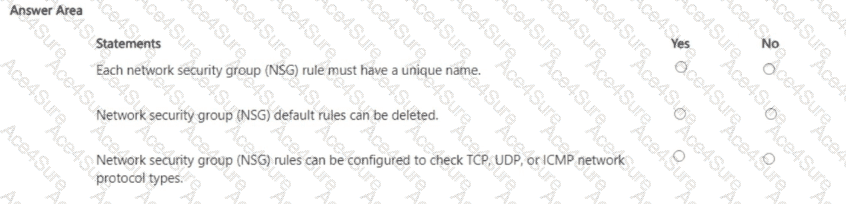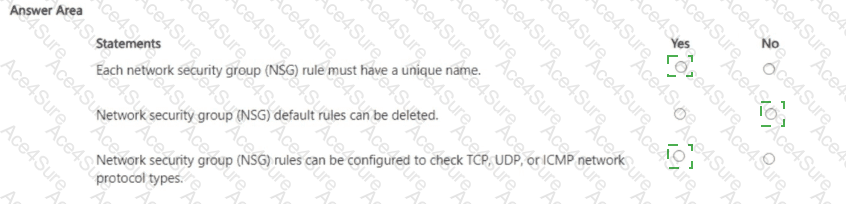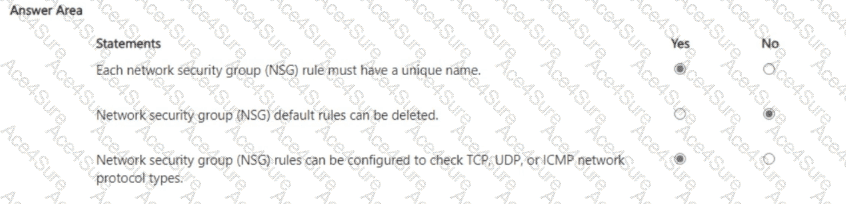
In Microsoft Azure, an NSG consists of ordered security rules evaluated by priority. The Azure documentation specifies that every rule includes identifying metadata and must be uniquely named within the NSG: “Each security rule has a name that is unique within the network security group.” Rule evaluation is deterministic: “Security rules are processed in priority order… once a rule matches traffic, processing stops.”
Azure creates several default security rules in every NSG to provide a safe baseline. These defaults are protected: “You can’t remove the default security rules, but you can override them by creating rules with a higher priority.” This means deletion of default rules is not allowed; administrators add custom rules with lower priority numbers to supersede the defaults as needed.
Regarding protocols, NSG rules can target specific L4/L3 protocols. The platform guidance states that the rule Protocol field supports TCP, UDP, ICMP, or Any: “For Protocol, specify TCP, UDP, ICMP, or Any.” Therefore, configuring rules to check TCP, UDP, or ICMP traffic types is fully supported.
Putting this together: (1) unique rule names are required (Yes), (2) default rules cannot be deleted (No), and (3) NSG rules can indeed be configured for TCP/UDP/ICMP (Yes). These behaviors align with Azure’s prescribed NSG design and management model used across Microsoft Security, Compliance, and Identity learning content.