
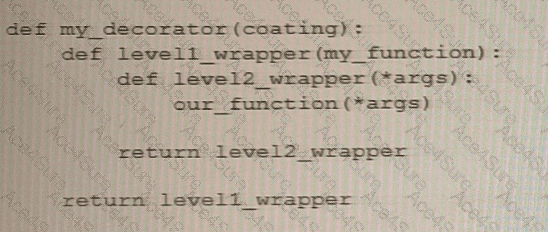
Analyze the following function and choose the statement that best describes it.
A.
It is an example of a decorator that accepts its own arguments.
B.
It is an example of decorator stacking.
C.
It is an example of a decorator that can trigger an infinite recursion.
D.
The function is erroneous.
The Answer Is:
A
This question includes an explanation.
Explanation:
In the given code snippet, the repeat function is a decorator that takes an argument num_times specifying the number of times the decorated function should be called. The repeat function returns an inner function wrapper_repeat that takes a function func as an argument and returns another inner function wrapper that calls func num_times times.
The provided code snippet represents an example of a decorator that accepts its own arguments. The @decorator_function syntax is used to apply the decorator_function to the some_function function. The decorator_function takes an argument arg1 and defines an inner function wrapper_function that takes the original function func as its argument. The wrapper_function then returns the result of calling func , along with the arg1 argument passed to the decorator_function .
Here is an example of how to use this decorator with some_function :
@ decorator_function ( "argument 1" )
def some_function ():
return "Hello world"
When some_function is called, it will first be passed as an argument to the decorator_function . The decorator_function then adds the string "argument 1" to the result of calling some_function() and returns the resulting string. In this case, the final output would be "Hello world argument 1" .
[Reference:, Official Python documentation on Decorators: https://docs.python.org/3/glossary.html#term-decorator, , , ]
PCPP-32-101 PDF/Engine
Printable Format
Value of Money
100% Pass Assurance
Verified Answers
Researched by Industry Experts
Based on Real Exams Scenarios
100% Real Questions
Get 65% Discount on All Products,
Use Coupon: "ac4s65"

