Exact Extract: “Segment the network. Macrosegmentation: Isolate different networks and VLANs from one another. Microsegmentation: Isolate the workloads of individual applications.” The guide further explains: “With macrosegmentation, you can isolate broadcast domains and implement different levels of security based on the network and VLANs a device belongs to. For example, you can have a ‘Guest’ network with limited access, whereas the ‘IT’ network can access critical devices such as the ‘Server’ network.”
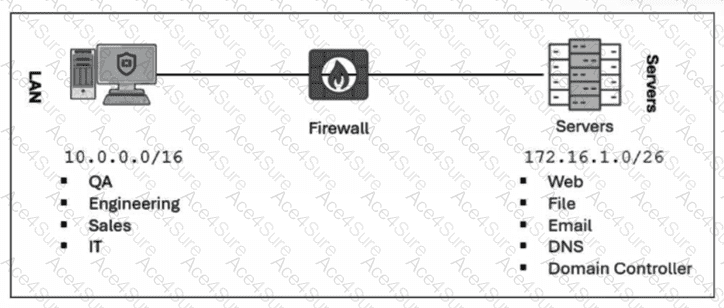
The correct answer is C because the exhibit shows a flat or broadly connected environment where multiple LAN departments—QA, Engineering, Sales, and IT—can reach a server network containing sensitive services such as web, file, email, DNS, and a domain controller. The most effective way to reduce the attack surface is macrosegmentation, meaning separation of major network zones or VLANs and enforcement of access policy between them. That limits unnecessary lateral movement and restricts which departments can access critical servers.
Option A improves visibility but does not reduce exposure by itself. Option B improves inspection depth but does not reduce which systems can communicate. Option D is a valid general hardening practice, but the exhibit does not show unused devices; it shows multiple business networks and server services requiring segmentation.
Technical Deep Dive: On FortiGate, macrosegmentation is normally implemented with VLANs, zones, firewall policies, and least-privilege rules between departments and server subnets. Example design: separate QA, Engineering, Sales, IT, and Server VLANs; then allow only required traffic such as Sales to web services, IT to domain controllers, and DNS from approved clients. NP/CP offloading can still accelerate eligible firewall sessions, but once UTM/deep inspection is enabled, some traffic may be handled by CPU or CP depending on the model and inspection profile.