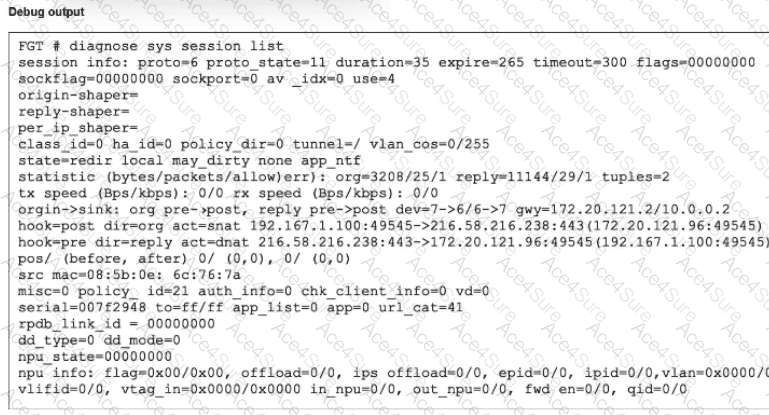
The session output includes the flags:
npu_state=00000000
offload=0/0
The 7.6 study guide explains these flags directly:
redir = “Session is being processed by an application layer proxy”
may_dirty = “Session is allowed by a firewall policy”
This makes C correct, because the local flag means the session either originates from FortiGate or terminates on FortiGate . The FortiOS administration guide states the same meaning: “Session is originated from or destined for local stack.”
This also makes A correct. The redir flag means the session is handled by an application-layer proxy . FortiOS documents explain that proxy-based inspection buffers traffic on the FortiGate and inspects it there, and that proxy-based processing is CPU and memory-intensive
Since the session also shows no NPU offload (npu_state=00000000, offload=0/0), this traffic is being handled in software/CPU, not by the NPU.
Why the other options are wrong:
B is wrong because the redir flag proves the session is not passing without inspection; it is being processed by an application-layer proxy
D is wrong because there is no authentication flag in this session. In Fortinet examples of captive portal/authentication-related sessions, the session state includes auth or authed flags. The study guide shows: “Any session for traffic coming from an authenticated user contains the authed flag.” This exhibit does not show auth or authed, so there is no basis to conclude the client was redirected to a captive portal for authentication.