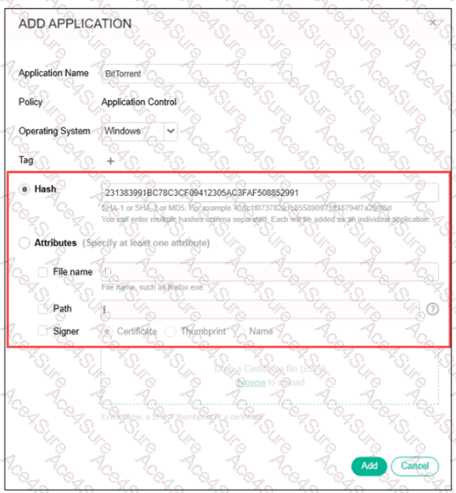
The FortiEDR 7.0.0 Administration Guide states that when manually adding applications to be blocked, you can define the application using Hash or using any combination of File Name / Path / Signer attributes. This means hashes can be used independently and do not require filename, path, or signer attributes.
The guide also states that each hash is a unique identifier of an individual application, and the exhibit itself shows the hash field note: “SHA-1 or SHA-2 or MD5.” Therefore, the hash must use a supported hash format, making D correct.
For multiple hash entries, the uploaded guide text says they must be comma separated , while the exhibit note says “You can enter multiple hashes comma separated.” So the technically exact guide wording supports comma separation, not line separation. However, given your answer choices, A is clearly trying to test the requirement that multiple hashes must be separated correctly. The option wording says “line-separated,” which is not exact against the guide; the better wording would be comma-separated . Since no “comma-separated” option is provided, A is the intended separation-related answer, but the wording is flawed.
Option B is definitely wrong because hash mode is an alternative to attributes. Option C is also not the best answer because, although each hash uniquely identifies a file/application variant, the operational requirement is not that “hashes must be unique to each application” in the way the option implies. Hashes may represent different variants of the same application.