Exact Extract:
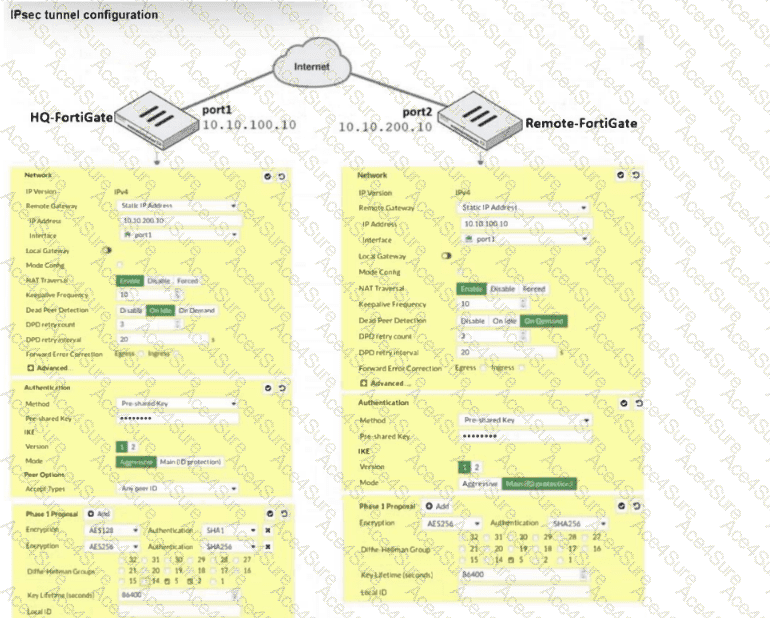
“In IKEv1, there are two possible modes in which the IKE SA negotiation can take place: main, and aggressive mode. Settings on both ends must agree; otherwise, phase 1 negotiation fails and both IPsec peers are not able to establish a secure channel.”
“When both peers know each other ' s IP address or FQDN, you may want to use main mode to take advantage of its more secure negotiation. In this case, FortiGate can identify the remote peer by its IP address and, as a result, associate it with the correct IPsec tunnel.”
“FortiGate supports three DPD modes... The default DPD mode is On Demand .”
“ Diffie-Hellman (DH) ... is used during IKE SA negotiation. The use of DH in phase 1 is mandatory and can’t be disabled . You must select at least one DH group.”
Technical Deep Dive:
The correct answers are B and C .
B is correct because phase 1 fails when IKE mode settings do not match between peers. The study guide explicitly says phase 1 settings on both ends must agree. Since this is a static site-to-site tunnel and both peers know each other’s IP addresses, Main (ID protection) is the appropriate mode.
C is correct based on the exhibit: BR1-FGT appears bound to the wrong physical interface. The screenshot shows Interface = port1 , while the diagram/answer choice indicates the tunnel should be using port2 . If the phase 1 is bound to the wrong WAN interface, FortiGate sends IKE packets out the wrong path and phase 1 will not come up.
Why the others are not the fix:
A is not correct because DH is mandatory in phase 1. The issue is not “disable DH group 2” by itself; the real requirement is that the peers negotiate a compatible proposal. The option as written is not the proper corrective action from the guide.
D is not correct because DPD does not determine whether phase 1 can initially establish. It is a tunnel health/failure-detection feature after negotiation behavior, and On Demand is already the default mode.