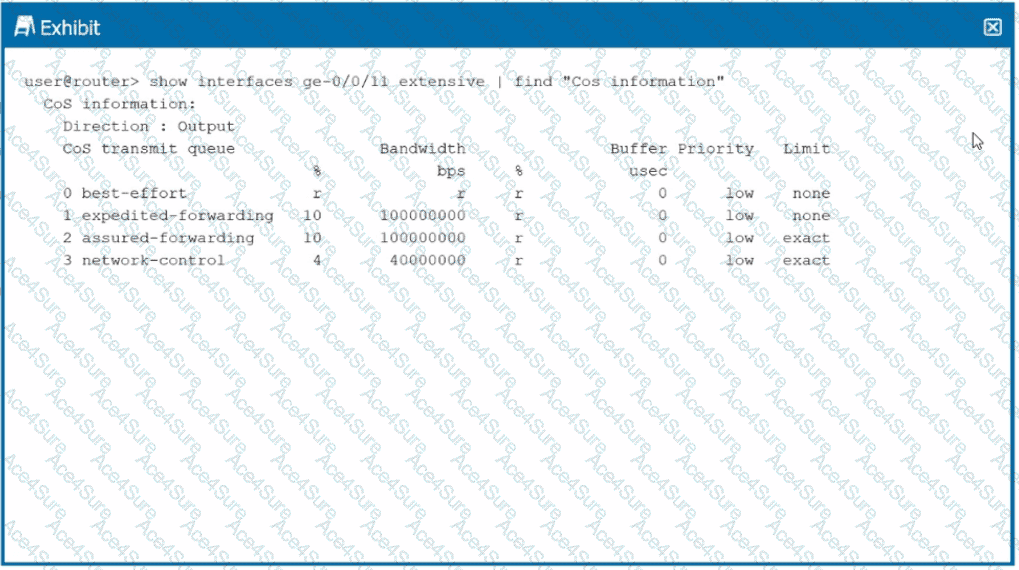
The exhibit shows the Class of Service (CoS) transmit queue information for interface ge-0/0/11. To determine the correct behavior, we must analyze the bandwidth allocations and the queue limit settings:
Bandwidth Calculation (Option A): In Junos OS, when multiple queues are assigned specific percentages of bandwidth, the " remainder " (represented by ' r ' ) is the total interface bandwidth minus the sum of the explicitly configured percentages.
Bandwidth assigned to Queue 1 (EF) = 10%.
Bandwidth assigned to Queue 2 (AF) = 10%.
Bandwidth assigned to Queue 3 (NC) = 4%.
Total explicitly assigned = $10\% + 10\% + 4\% = 24\%$.
Remainder for Queue 0 (Best Effort) = $100\% - 24\% = 76\%$.
" Limit: exact " Behavior (Option B): The exhibit shows that Queue 2 (assured-forwarding) has a Limit set to exact.
By default, a queue in Junos can consume more than its allocated bandwidth if other queues are idle.
However, when the exact keyword is applied to the transmit-rate (transmission rate), the queue is strictly rate-limited to its configured percentage.
This means that traffic in Queue 2 will be capped at 10% of the interface bandwidth regardless of whether the network is congested or not. If the traffic exceeds 10%, the excess will be dropped or buffered to match the exact rate.
Option C is incorrect because 100% of the bandwidth is not reserved for a single queue; it is distributed across four queues.
Option D is less accurate than B because it implies the drop behavior only occurs during congestion. The exact parameter enforces the limit even when the rest of the interface is completely idle.