
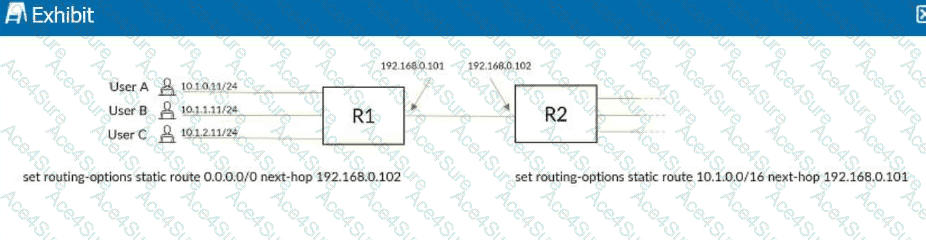
Which statement is correct about traffic flow in the network shown in the exhibit?
A.
A routing loop can occur if one of the users sends packets to 10.1.99.1.
B.
Only User A can reach destinations beyond Router R1.
C.
Router R2 will drop packets destined for user B and user C.
D.
Router R1 will discard all packets from all three users.
The Answer Is:
A
This question includes an explanation.
Explanation:
The configuration exhibit demonstrates a classic scenario where mismatched static routing leads to a routing loop . Router R1 is configured with a default route ( 0.0.0.0/0 ) pointing to R2 as its next hop. Conversely, R2 is configured with a broad static route for 10.1.0.0/16 pointing back to R1 .
If a user sends a packet to an unassigned IP address such as 10.1.99.1 , the following sequence occurs:
R1 receives the packet and consults its routing table. Finding no specific match for the 10.1.99.1 host, it uses the default route and forwards the packet to R2 .
R2 receives the packet and identifies that 10.1.99.1 falls within its defined static route for 10.1.0.0/16 .
Following its configuration, R2 forwards the packet back to R1 . This process repeats indefinitely—or until the packet ' s Time to Live (TTL) reaches zero—because the broad summary on R2 encompasses addresses that R1 does not actually have a local path for. This illustrates the critical importance of ensuring that summary routes or default routes do not overlap in a way that creates circular forwarding paths for non-existent destinations. Reference: Routing Fundamentals, Static Route Configuration, Routing Loops and TTL.
==========
JN0-106 PDF/Engine
Printable Format
Value of Money
100% Pass Assurance
Verified Answers
Researched by Industry Experts
Based on Real Exams Scenarios
100% Real Questions
Get 65% Discount on All Products,
Use Coupon: "ac4s65"

