
The output of the show LACP interfaces shows the following:
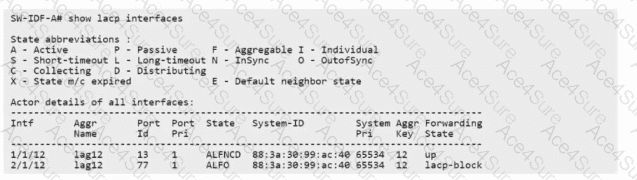
What is causing this issue?
A.
The AP is configured with LACP active.
B.
Each AP interface is connected to a routed-only interface on different networks.
C.
Spanning tree and loop protect are enabled on both AP uplink ports.
D.
e0 is connected to a smart rate interface, and e is connected to a non-smart rate interface.
The Answer Is:
D
This question includes an explanation.
Explanation:
On Aruba CX, LAG members must be link compatible (same speed/duplex and L2 characteristics). If one AP uplink (e0) negotiates SmartRate (e.g., 2.5/5 GbE) while the other (e1) negotiates 1 GbE, the switch detects the speed mismatch between the two member links and will not place both links in the distributing state. The second link is held in lacp-block to prevent forwarding on an incompatible member.
LACP active/passive (Option A) would affect whether a bundle forms at all, not cause lacp-block on just one member.
Routed-only interfaces (Option B) would prevent L2 aggregation entirely, not partially form with one member blocked.
Spanning tree/loop protect (Option C) do not produce an LACP member state of lacp-block.
Therefore, mixing a SmartRate port with a non-SmartRate port in the same LAG is the cause of the lacp-block state.
HPE7-A07 PDF/Engine
Printable Format
Value of Money
100% Pass Assurance
Verified Answers
Researched by Industry Experts
Based on Real Exams Scenarios
100% Real Questions
Get 65% Discount on All Products,
Use Coupon: "ac4s65"

