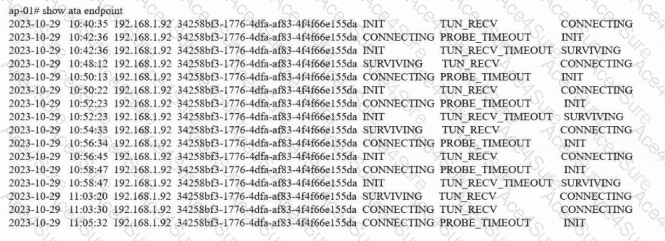
AP-01's tunnel to 192.168.1.92 is in a survived state.
B.
The gateway with IP address 192.168.1.92 is offline.
C.
AP-01 cannot communicate with the HPE Aruba Networking Central tunnel orchestrator.
D.
The gateway tunnel to the AP has a path MTU issue.
The Answer Is:
B
This question includes an explanation.
Explanation:
The show ata endpoint output lists the AP’s AP Tunnel Agent (ATA) state transitions with a given gateway.
Key state/result fields:
CONNECTING → PROBE_TIMEOUT → INIT: the AP tries to bring up the IPSec tunnel, health probes to the gateway time out, then the state resets to INIT and retries.
TUN_RECV_TIMEOUT: the AP stops receiving tunnel keepalives/packets from the gateway within the expected interval.
SURVIVING indicates the AP is maintaining service with an already-up tunnel while control connectivity is impaired; it is not the state shown at the end here.
In the log, AP-01 repeatedly cycles through CONNECTING → PROBE_TIMEOUT → INIT, with intermittent TUN_RECV_TIMEOUT. This pattern is the documented symptom of the gateway being unreachable or down (no response to probes/keepalives), rather than a Central/orchestrator outage or PMTU problem.
Therefore, the correct conclusion is that the gateway at 192.168.1.92 is offline or not reachable.
A is incorrect: the final/recurring state is not SURVIVING.
C is incorrect: a Central/orchestrator issue would show SURVIVING (existing tunnel continues) rather than repeated probe timeouts to the gateway.
D is incorrect: PMTU issues do not generate recurring PROBE_TIMEOUT/TUN_RECV_TIMEOUT cycles; they appear as ESP/IKE negotiation problems, not persistent probe loss.
HPE7-A07 PDF/Engine
Printable Format
Value of Money
100% Pass Assurance
Verified Answers
Researched by Industry Experts
Based on Real Exams Scenarios
100% Real Questions
Get 65% Discount on All Products,
Use Coupon: "ac4s65"