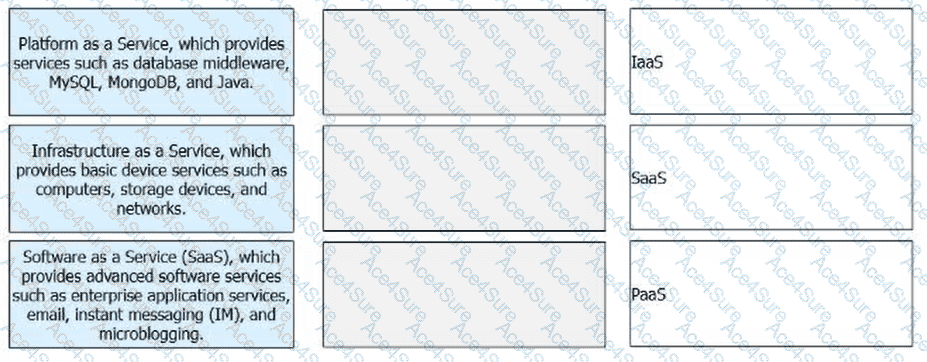
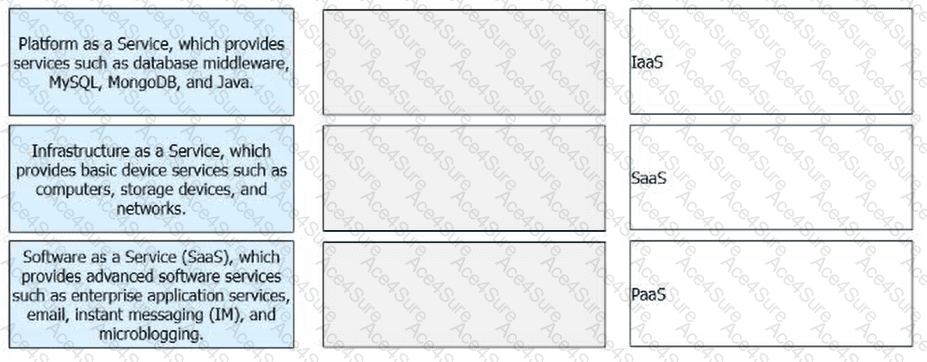
1 → PaaS
2 → IaaS
3 → SaaS
The three mappings correspond directly to Huawei Cloud's definitions of the standard cloud service models. Infrastructure as a Service (IaaS) supplies foundational infrastructure resources such as compute, storage, and networking. Huawei Cloud services such as ECS, VPC, VPN, and OBS are representative infrastructure-level services. Therefore, the description referring to computers, storage devices, and networks maps to IaaS.
Platform as a Service (PaaS) provides managed platform capabilities used to develop, deploy, and operate applications. Huawei Cloud characterizes PaaS as including middleware, database platforms, development environments, microservice capabilities, and related application-platform resources. Consequently, the database/middleware/MySQL/MongoDB/Java-oriented description belongs to PaaS.
Software as a Service (SaaS) delivers complete applications to end users. Customers consume the application rather than maintaining the underlying operating system, middleware, runtime, and infrastructure. Enterprise applications, messaging systems, email services, collaboration applications, and similar ready-to-use software fit this model.
The correct progression is therefore PaaS → IaaS → SaaS for the three descriptions shown in the question.
Reference topics: Cloud Service Models; IaaS; PaaS; SaaS; Huawei Cloud Service Architecture.
===============