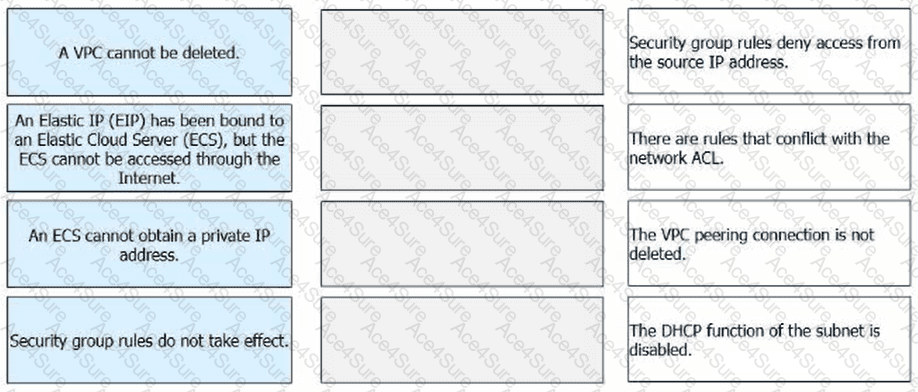
Match the following fault scenarios with possible causes:
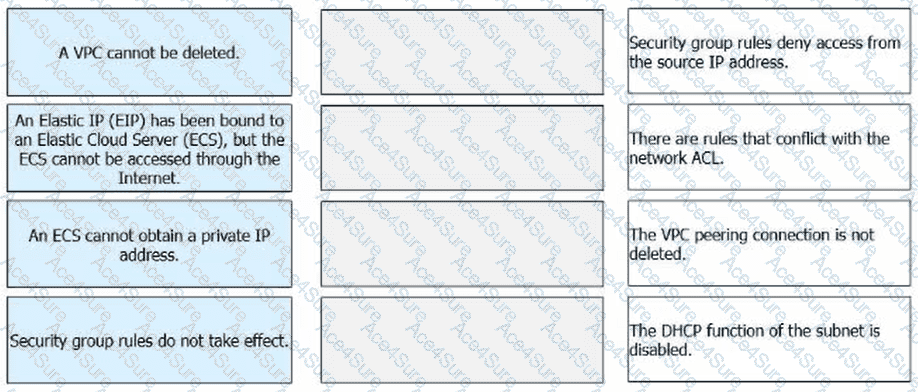
The Answer Is:
Answer:
This question includes an explanation.
Explanation:
1 → C
2 → A
3 → D
4 → B
Each fault maps to a specific Huawei Cloud VPC control. A VPC cannot be deleted while dependent resources such as a VPC peering connection still use it, so scenario 1 maps to C. Huawei Cloud explicitly lists VPC peering connections among resources that must be removed before VPC deletion.
For scenario 2, merely binding an EIP does not override security-group filtering. If the relevant inbound security-group rule does not permit traffic from the source IP address and required protocol/port, the ECS remains inaccessible externally; therefore it maps to A.
Scenario 3 maps to D. Huawei Cloud uses DHCP to allocate private addresses dynamically, and its troubleshooting guidance specifically instructs administrators to verify whether the subnet's DHCP function is enabled when an ECS cannot obtain a private IP address.
Scenario 4 maps to B. Huawei documentation explicitly identifies conflicting network ACL and security-group rules as a cause of security-group rules appearing ineffective. The network ACL can block traffic that the security group otherwise permits.