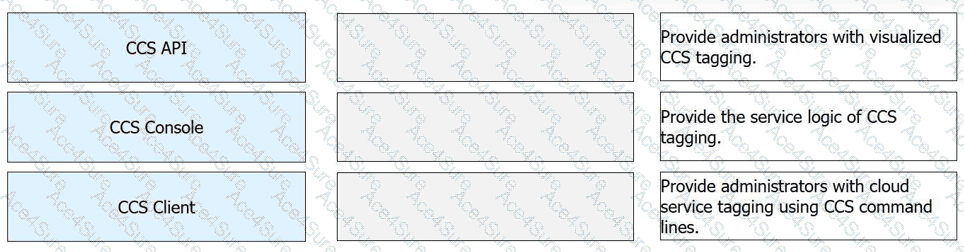
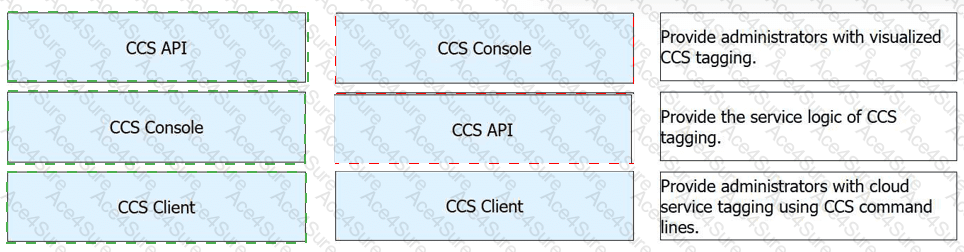
CCS API → Provide the service logic of CCS tagging
CCS Console → Provide administrators with visualized CCS tagging
CCS Client → Provide administrators with cloud service tagging using CCS command lines
Comprehensive and Detailed 150 to 200 words of Explanation From HUAWEI CLOUD Computing Topics:
This drag-and-drop match follows the normal architectural roles of Huawei Cloud Stack CCS components. The CCS API is the backend service interface, so it is responsible for the service logic of CCS tagging . In cloud platforms, APIs handle request processing, tag creation, tag query, and tag-management actions exposed to other components or clients. The CCS Console is the graphical management interface, so its role is to provide administrators with visualized CCS tagging . This means administrators can perform tag-related operations through a web-based UI rather than command lines. The CCS Client is the command-line access component, so it is used to provide administrators with cloud service tagging using CCS command lines .
This mapping is also consistent with standard Huawei Cloud Stack component design principles: API for backend logic , Console for visual management , and Client for CLI-based operations . In practical cloud O & M and resource governance, these three components complement each other by supporting programmatic integration, web-based administration, and command-line automation. Therefore, the verified matching is: CCS API → service logic , CCS Console → visualized tagging , and CCS Client → command-line tagging .