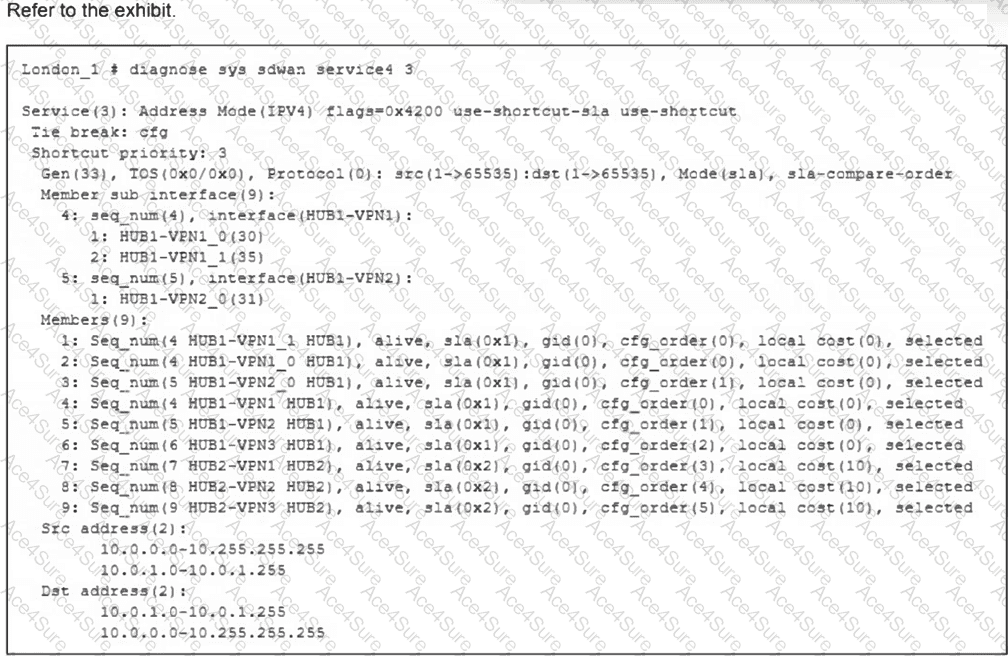
The command shown in the exhibit is:
diagnose sys sdwan service 4 3
This command displays the runtime state of SD-WAN rule ID 3 on the device. The output explicitly shows:
Service(3) which confirms the SD-WAN rule being evaluated is rule number 3
Members(9) which indicates that nine SD-WAN members are associated with this rule
The listed members include multiple IPsec tunnel interfaces such as HUB1-VPN1, HUB1-VPN2, HUB1-VPN3, HUB2-VPN1, HUB2-VPN2, and HUB2-VPN3, which is characteristic of a spoke device connecting to multiple hubs in a hub-and-spoke ADVPN topology, as defined in the FCSS SD-WAN 7.6 architecture.
Option B is incorrect because, although members are listed under different interfaces, the output does not indicate SD-WAN zones. Zones are shown only in configuration output, not in this diagnostic command.
Option C is incorrect because this is not a hub device. The presence of multiple hub tunnels as SD-WAN members indicates a spoke role. Additionally, the output does not confirm the number of established ADVPN shortcuts.
Option D is incorrect because the output clearly references SD-WAN rule 3, not rule 4, and it does not state that exactly three shortcut tunnels are allowed.
Therefore, the correct conclusion is that this is a spoke device and SD-WAN rule 3 is configured with nine members, which matches option A.