The correct answer is C .
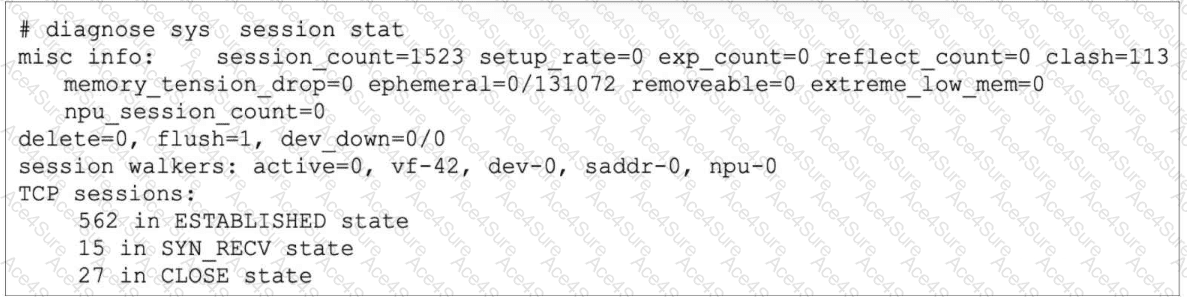
The exhibit shows:
562 in ESTABLISHED state
27 in CLOSE state
memory_tension_drop=0
ephemeral=0/131072
According to the study guide, for TCP sessions: “The protocol state in the session table is a two-digit number. For TCP, the first number (from left to right) is related to the server-side state and is 0 when the session is not subject to any inspection (flow or proxy)… The second digit is the client-side state.” The same page also shows that value 1 = ESTABLISHED
So, if a TCP session is in ESTABLISHED state and there is no inspection , its proto_state is 01 :
first digit 0 = no inspection
second digit 1 = ESTABLISHED
That makes C correct. This is also consistent with FortiOS examples showing established TCP sessions with proto=6 proto_state=01
Why the other options are wrong:
A is wrong because the field that indicates sessions dropped due to low free memory is memory_tension_drop, and in the exhibit it is 0 , not 113. The study guide states: “If there is a lack of free memory, the kernel deletes the oldest sessions. The command shown on this slide displays the number of sessions the kernel deleted because of this mechanism.” So 113 is the clash value, not memory-tension drops.
B is wrong because ephemeral=0/131072 does not mean 131072 ephemeral sessions were recorded. The study guide explains that FortiGate “sets a hard limit on the maximum number of ephemeral sessions that can exist at the same time in the session table.” Therefore:
0 = current ephemeral sessions
131072 = maximum allowed ephemeral sessions for that model/context
D is wrong because the study guide says the temporary retention for possible out-of-order packets happens in state value 5 (TIME_WAIT) : “When a session is closed by both the sender and receiver, FortiGate keeps that session in the session table for a few seconds, to allow for any out-of-order packets that might arrive after the FIN/ACK packet. This is the state value 5.” But the exhibit shows 27 in CLOSE state , and the same table shows CLOSE = 6 , not TIME_WAIT
So the verified answer is C .