Comprehensive and Detailed Explanation From Exact Extract–Based NCC C-EFM References:
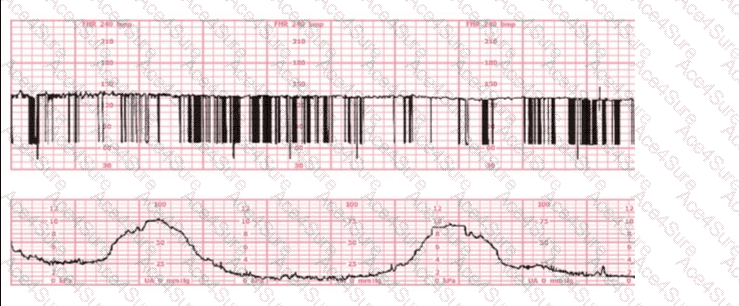
When evaluating an admission tracing, NCC emphasizes determining whether the pattern represents baseline variability abnormalities, signal artifact, or an underlying fetal cardiac rhythm disturbance. The strip shown contains clear features of a fetal dysrhythmia, which NCC and AWHONN describe as an irregular rhythm characterized by inconsistent R–R intervals or intermittent missed beats.
Key features in this tracing:
Extremely irregular FHR signalThe pattern shows abrupt vertical spikes, inconsistent spacing, and intermittent loss of coherent waveform. NCC teaches that this appearance is typical of irregular ventricular conduction or premature atrial/ventricular contractions.
Wide variability in beat spacingBeat intervals vary significantly, suggesting ectopic beats or conduction abnormalities rather than a stable rhythm such as heart block or atrial flutter.
Sensor not malfunctioningThe lower uterine activity channel is smooth and consistent, meaning the upper channel’s abrupt changes represent true FHR signal irregularity, not artifact.
Why the incorrect answers are ruled out:
A. Atrial flutter – NOT supported
Atrial flutter produces a very fast, regular atrial rate (typically 300 bpm) with a repetitive saw-tooth pattern.
It does not produce the highly irregular beat-to-beat pattern seen here.
FHR in atrial flutter appears more organized, not chaotic.
B. Complete heart block – NOT supported
Complete heart block (third-degree AV block) produces a very slow, regular ventricular rate, commonly 50–70 bpm, with a dissociation between atrial and ventricular rhythms.
The tracing here does not show a slow, steady baseline.
Instead, the rhythm is highly irregular with spikes and losses—not characteristic of AV block.
C. Fetal dysrhythmia – CORRECT
NCC, AWHONN, Miller, and Menihan describe fetal dysrhythmias as:“Irregular, inconsistent FHR patterns due to premature atrial contractions (PACs), premature ventricular contractions (PVCs), or intermittent conduction disturbances.”
The hallmark is an irregular rhythm, often appearing as abrupt spikes or missing beats on the monitor.
The tracing shown matches these characteristics precisely.
Therefore, the tracing is most consistent with fetal dysrhythmia, typically benign PACs/PVCs, and is the correct answer.
[References:NCC C-EFM Candidate Guide (2025); NCC Content Outline; AWHONN Fetal Heart Monitoring Principles & Practices; Miller’s Fetal Monitoring Pocket Guide; Menihan Electronic Fetal Monitoring; Simpson & Creehan Perinatal Nursing; Creasy & Resnik Maternal–Fetal Medicine., ]