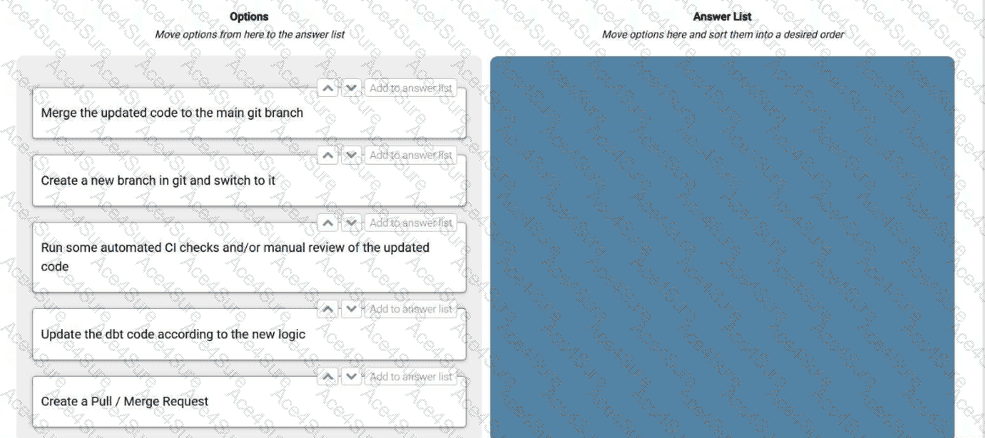
Create a new branch in git and switch to itB. Update the dbt code according to the new logicC. Create a Pull / Merge RequestD. Run some automated CI checks and/or manual review of the updated codeE. Merge the updated code to the main git branch
Version control best practices in dbt follow the same engineering workflow used in modern software development. The first step is always to create a new git branch and switch into it, ensuring all work is isolated from production-ready code and allowing your team to develop safely without affecting others. Once inside the feature branch, you update the dbt code according to the new logic, which may include modifying models, tests, macros, or documentation.
Next, you create a Pull Request (PR), also known as a Merge Request, to propose integrating your changes into the main branch. This is important because dbt projects are collaborative, and PRs facilitate peer review, enforce project standards, and prevent regressions. Once the PR is created, automated CI pipelines—such as running dbt build, schema tests, data quality checks, and code-style checks—are executed. Reviewers may also manually inspect code for logic correctness, naming conventions, and modeling consistency.
After all checks have passed and reviewers approve the PR, the final step is to merge the updated code into the main branch, making the new transformations part of the production dbt project. This workflow ensures governance, reliability, and auditable development practices, all of which are core principles in analytics engineering.