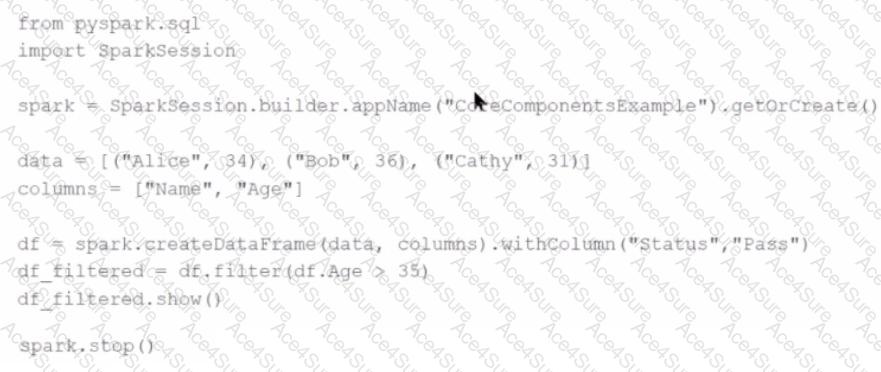
Comprehensive and Detailed Explanation From Exact Extract:
In the Spark architecture, the driver node is responsible for orchestrating the execution of a Spark application. It converts user-defined transformations and actions into a logical plan, optimizes it into a physical plan, and then splits the plan into tasks that are distributed to the executor nodes.
As per Databricks and Spark documentation:
“The driver node is responsible for maintaining information about the Spark application, responding to a user's program or input, and analyzing, distributing, and scheduling work across the executors.”
This means:
Option A is correct because the driver schedules and coordinates the job execution.
Option B is incorrect because the driver does more than just UI monitoring.
Option C is incorrect since data and computations are distributed across executor nodes.
Option D is incorrect; results are returned to the driver but not stored long-term by it.
[Reference: Databricks Certified Developer Spark 3.5 Documentation → Spark Architecture → Driver vs Executors., ]