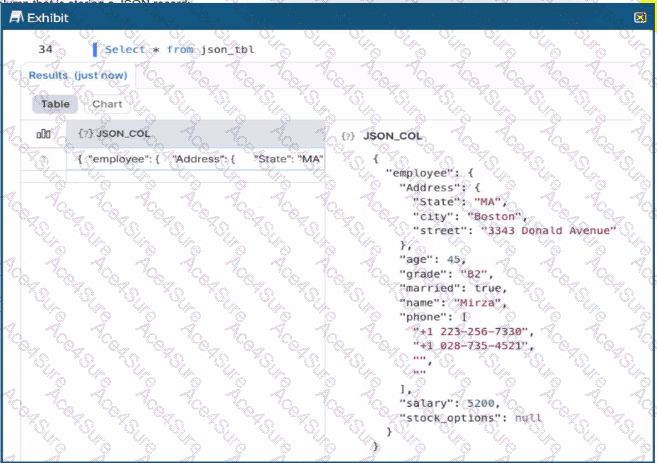
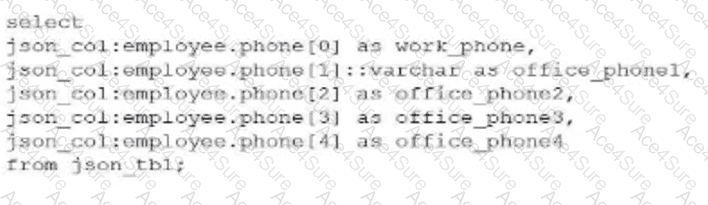
To correctly predict the output of this query, a Data Analyst must understand how Snowflake handles semi-structured data (JSON), specifically regarding path notation, data type casting, and the display of VARIANT values in the Snowsight UI.
1. Variant vs. Casted Types (Display): When you access a value within a JSON object using colon notation (e.g., json_col:employee.phone[0]), the resulting value is of the VARIANT data type. In the Snowflake Snowsight results pane, VARIANT strings are displayed with double quotes (e.g., "+1 223-256-7330"). However, when you explicitly cast a variant to a string type using the double-colon syntax (e.g., ::varchar), Snowflake extracts the value as a native SQL string, which is displayed without quotes (e.g., +1 028-735-4521).
2. Handling Empty Strings vs. Out-of-Bounds: In the provided JSON exhibit, the phone array contains four elements at indices 0, 1, 2, and 3. The elements at indices 2 and 3 are empty strings (""). When these are queried, Snowflake returns the empty string variant, which appears as "" in the result set. The query also attempts to access phone[4]. Since the array only has four elements (max index 3), index 4 is out-of-bounds. In Snowflake, accessing a non-existent index in an array or a non-existent key in an object returns NULL.
Evaluating the Options based on the exhibit:
Option B correctly reflects all these behaviors: WORK_PHONE is in quotes (Variant), OFFICE_PHONE1 is not in quotes (Casted), OFFICE_PHONE2 and OFFICE_PHONE3 show the empty strings present in the JSON, and OFFICE_PHONE4 correctly shows null for the out-of-bounds access.
Option A is incorrect because it misses the quotes for the variant column and shows the out-of-bounds index as an empty string instead of null.
Option C is incorrect because it fails to account for the empty strings present at indices 2 and 3.
Option D incorrectly mixes the casting logic and display.
This question tests the "Schema-on-Read" proficiency required of a SnowPro Advanced: Data Analyst, specifically the ability to predict exactly how transformed semi-structured data will materialize for end-users.