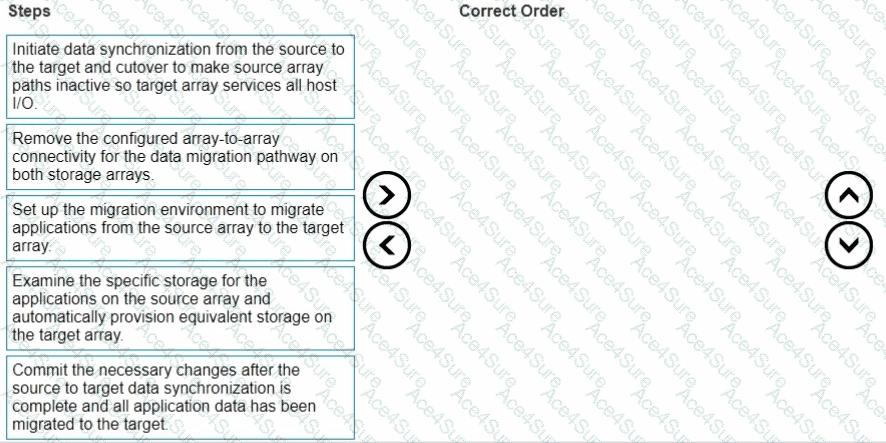
Place the steps in the correct order for performing a Non-Disruptive Migration
The Answer Is:
Answer:
This question includes an explanation.
Explanation:
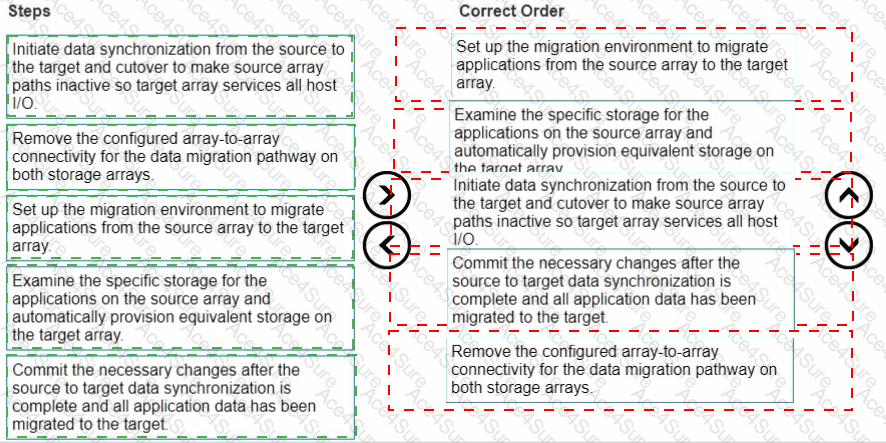
Set up the migration environment to migrate applications from the source array to the target array.
Examine the specific storage for the applications on the source array and automatically provision equivalent storage on the target array.
Initiate data synchronization from the source to the target and cutover to make source array paths inactive so target array services all host I/O.
Commit the necessary changes after the source to target data synchronization is complete and all application data has been migrated to the target.
Remove the configured array-to-array connectivity for the data migration pathway on both storage arrays.
Correct Order:
Set up the migration environment to migrate applications from the source array to the target array.
Why:This is the initial setup phase, where you configure the necessary settings on both the source and target arrays to enable the migration. This involves actions like:
Verifying compatibility between the source and target arrays.
Ensuring that the required licenses are in place (e.g., NDM license).
Configuring network connectivity (FC or iSCSI) for data transfer between the arrays.
Examine the specific storage for the applications on the source array and automatically provision equivalent storage on the target array.
Why:Before migrating data, you need to ensure that the target array has the appropriate storage capacity and configuration to host the applications.
How:NDM can often automatically provision equivalent storage on the target based on the source configuration. This includes creating storage groups, volumes, and masking views that mirror the source.
Initiate data synchronization from the source to the target and cutover to make source array paths inactive so target array services all host I/O.
Why:This is the core of the migration process. Data is copied from the source to the target while the application continues to run. Cutover is the final step where I/O is redirected to the target array.
How:
Synchronization:Data is copied in the background.
Cutover:Once synchronization is complete, a brief cutover is performed. In a well-planned NDM, this cutover is designed to be within the I/O timeout limits of most applications.
Commit the necessary changes after the source to target data synchronization is complete and all application data has been migrated to the target.
Why:This step finalizes the migration and makes it permanent.
What it involves:The migration session is acknowledged and the configuration is finalized on the target array.
Remove the configured array-to-array connectivity for the data migration pathway on both storage arrays.
Why:After the migration is complete, the temporary connections used for data transfer between the arrays should be removed to free up resources and maintain a clean configuration.
What it involves:This typically means removing the FC zones or iSCSI settings that were configured specifically for the NDM process.
D-PVM-OE-01 PDF/Engine
Printable Format
Value of Money
100% Pass Assurance
Verified Answers
Researched by Industry Experts
Based on Real Exams Scenarios
100% Real Questions
Get 65% Discount on All Products,
Use Coupon: "ac4s65"