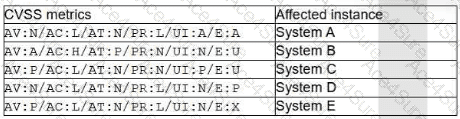
Using CVSS v4.0, the highest-priority remediation is typically the vulnerability that is most remotely exploitable and requires the least attacker effort (low complexity, no special conditions, low/no privileges, and no user interaction).
System D is the strongest “fix first” candidate because it combines:
AV:N (Network) → remotely exploitable over the network; severity increases the more remote the attacker can be.
AC:L (Low) → easier to exploit than High complexity.
AT:N (None) → “does not depend on deployment/execution conditions”; attacker can expect the exploit to work under most instances.
PR:L (Low) → only basic user privileges required (still relatively accessible).
UI:N (None) → most important differentiator vs System A. CVSS v4.0 explicitly states: “The resulting score is greatest when no user interaction is required.”
E:P (Proof-of-Concept) → publicly available PoC code exists (more exploitable than “Unreported”), increasing urgency compared to U.
Why not System A (the closest competitor)?
System A is also AV:N/AC:L/AT:N/PR:L, but it has UI:A (Active), meaning exploitation requires a targeted user to perform specific actions. CVSS v4.0 defines Active (A) as requiring “specific, conscious interactions… or actively subvert protection mechanisms.”
System D’s UI:N makes it exploitable purely at the attacker’s will, which CVSS treats as more severe.
Why the others are lower priority
System B (AV:A, AC:H, AT:P): adjacent-only, high complexity, and attack requirements present → significantly harder/less broadly exploitable.
System C (AV:P) and System E (AV:P): require physical access, which reduces the pool of potential attackers and generally lowers priority versus network-exploitable issues.
References (Official CVSS v4.0 specification used):
FIRST, CVSS v4.0 Specification Document:
User Interaction values (None/Passive/Active) and “score is greatest when no user interaction is required”
Attack Requirements (AT) definitions (None vs Present)
Exploit Maturity (E) values (X/A/P/U) and meanings
Attack Vector remoteness increases severity