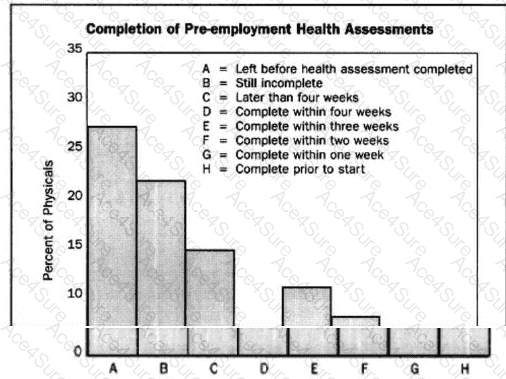
The data indicates that only a small percentage of employees completed their health assessments within the stipulated time frame prior to or shortly after starting employment. Summing the percentages for timely completion (D, E, F, G, H) gives approximately 31% (3% + 11% + 7% + 6% + 4%), meaning that about 69% did not complete the assessments in time or left before completion (A, B, C categories). Since the program requires assessments to be completed before duties begin, this represents a substantial noncompliance.
This aligns with principles from The Joint Commission’s Performance Improvement standards and Occupational Safety and Health Administration (OSHA) guidelines on employee health programs, emphasizing the need for timely completion of pre-employment assessments to ensure workforce safety and regulatory compliance.
Option A is not directly supported because the data only shows incomplete assessments but does not explicitly link this to terminations.
Option B is inaccurate as only about 31% met the requirement, not 35%, and compliance is generally expected to be higher.
Option C is incorrect since compliance is clearly inadequate based on the data.
Option D correctly reflects the fact that approximately 95% (if including A, B, C categories where assessments are incomplete or delayed) failed to meet the objectives, demonstrating a significant issue with the program's implementation.
[References:, The Joint Commission, Comprehensive Accreditation Manual for Hospitals (CAMH), 2024 Edition, Chapter on Performance Improvement, OSHA, Occupational Health and Safety Guidelines, 2023, National Institute for Occupational Safety and Health (NIOSH), Employee Health Program Guidelines, 2023, , , , , , ]