Detailed Explanation:
The correct answer is B. Step B.
A process constraint, also called a bottleneck, is the step with the lowest capacity in the overall process. In a sequential flow, the entire system can only produce at the rate of its slowest step.
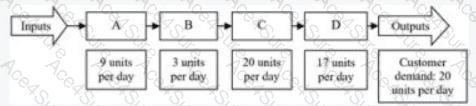
From the diagram:
Step A = 9 units per day
Step B = 3 units per day
Step C = 20 units per day
Step D = 17 units per day
Customer demand = 20 units per day
Since Step B has the smallest processing capacity, it limits the output of the whole process to 3 units per day, regardless of how much capacity the other steps have.
That is why Step B is the process constraint.
Why the other options are incorrect:
A. Step A
Step A can process 9 units per day, which is higher than Step B. Since it is not the lowest-capacity step, it is not the constraint.
C. Step C
Step C can process 20 units per day, which is the highest capacity shown and matches customer demand. It is clearly not the limiting step.
D. Step D
Step D can process 17 units per day, which is also much higher than Step B. Although it is below customer demand, it is still not the smallest capacity in the process.
From a Quality Management Excellence perspective, this question should be answered using direct process evidence and system logic:
identify the capacity of each step,
compare the values,
determine the step that restricts overall throughput.
This follows the Quality Management Excellence approach of using observable data, cause-and-effect reasoning, and selecting the conclusion that is most directly supported by the process information provided.
In practical quality and operational excellence terms, once the constraint is identified, improvement efforts should focus first on that step, because improving non-constraint steps will not significantly increase total system output while the bottleneck remains unchanged.