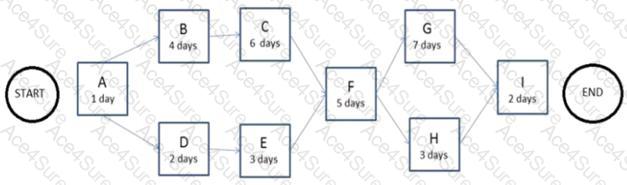
According to the PMBOK® Guide (Project Management Body of Knowledge), specifically the Project Schedule Management knowledge area and the Develop Schedule process, calculating the total float requires identifying the Critical Path and comparing it to the other paths in the network diagram.
Identify all possible paths and their durations:
Path 1: A → B → C → F → G → I
Path 2: A → B → C → F → H → I
Path 3: A → D → E → F → G → I
Path 4: A → D → E → F → H → I
Determine the Critical Path:
The Critical Path is the longest path through the network. In this case, Path 1 (A-B-C-F-G-I) is the Critical Path with a duration of 25 days. The float on the Critical Path is $0$.
In PMI terminology, when a question asks for the " total float for the project " in the context of specific non-critical paths, it is typically referring to the amount of time a specific path can be delayed without delaying the project finish date.
The question asks for the total float of the project (often interpreted as the float of the secondary path or the difference between the longest and shortest paths if phrased generally). However, mathematically, the Total Float for the activities on the " near-critical " path (Path 3) compared to the Critical Path (Path 1) is:
By definition in the Standard for Scheduling, Total Float is the amount of time that a schedule activity can be delayed or extended from its early start date without delaying the project finish date. The primary non-critical sequence (starting with A-D-E) has 5 days of flexibility before it impacts the 25-day completion target set by the critical path.