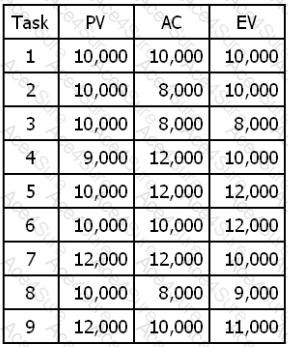
According to the PMBOK® Guide (Project Management Body of Knowledge), specifically within the Project Cost Management knowledge area and the Control Costs process, the Cost Performance Index (CPI) is a measure of the cost efficiency of budgeted resources, expressed as the ratio of earned value to actual cost.
To calculate the CPI for Task 2 using the data provided in the table:
Identify the variables for Task 2:
Earned Value (EV) = 10,000
Actual Cost (AC) = 8,000
Apply the CPI Formula:
$$\text{CPI} = \frac{\text{EV}}{\text{AC}}$$
$$\text{CPI} = \frac{10,000}{8,000} = 1.25$$
Option C (1.25): This is the correct calculation. A CPI greater than 1.0 indicates that the project is performing better than planned regarding cost (under budget). In this case, for every dollar spent on Task 2, $1.25$ worth of work was actually accomplished.
Option A (0.8): This would be the result if you incorrectly divided AC by EV ($8,000 / 10,000$). This would represent a project over budget, which is not the case for Task 2.
Option B (1): This would occur if EV and AC were equal (as seen in Task 1 or Task 6), indicating project performance exactly on budget.
Option D (1.8): This is mathematically incorrect based on the provided Task 2 figures.
In the PMI framework, the Cost Performance Index (CPI) is considered the most critical EVM metric. It allows the Project Manager to determine if the project ' s current spending efficiency is sustainable and is used as a primary input for calculating the Estimate at Completion (EAC).