Azure Virtual Network (VNet) peering allows two virtual networks to communicate privately across the Azure backbone network. According to Microsoft Azure Administrator documentation, VNet peering can be of two main types:
Regional VNet Peering: within the same Azure region and cloud type.
Global VNet Peering: across Azure regions, but within the same Azure cloud.
Microsoft Azure operates multiple sovereign clouds, which are logically and physically isolated:
Azure Global/Public Cloud (used by most commercial customers).
Azure Government Cloud (for U.S. government agencies and contractors, physically isolated from the public cloud).
Azure China Cloud (operated by 21Vianet, completely independent of Microsoft’s global Azure).
Per Microsoft Learn – Virtual Network Peering Documentation, the following restrictions apply:
“VNet peering cannot be established between Azure sovereign clouds (such as between Azure Government, Azure China, and Azure Public regions). Peering is only supported within the same cloud type, whether within a region or across regions.”
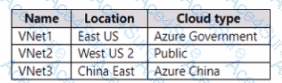
Based on the table:
VNet1 (East US, Azure Government)
VNet2 (West US 2, Public)
VNet3 (China East, Azure China)
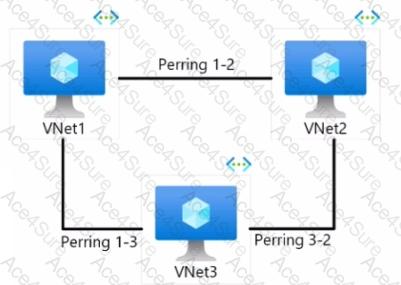
Analysis of each peering configuration:
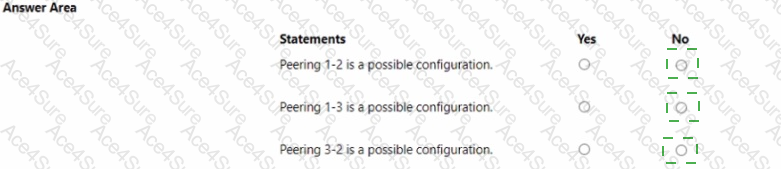
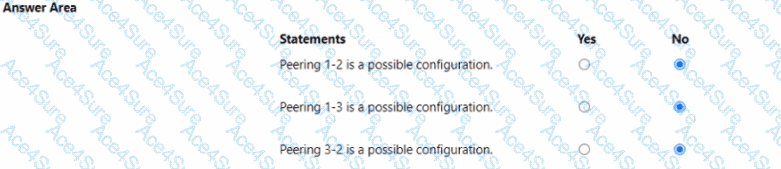
Peering 1–2 (Azure Government ↔ Public Cloud): ❌ Not supported.
Azure Government and Azure Public are separate environments — no peering across these cloud boundaries.
Peering 1–3 (Azure Government ↔ Azure China): ❌ Not supported.
These are two isolated sovereign clouds with independent infrastructure.
Peering 3–2 (Azure China ↔ Public Cloud): ❌ Not supported.
Azure China is operated by 21Vianet and cannot connect directly with the Public Azure cloud.
Therefore, no cross-cloud peering is supported among these networks.
If all VNets were within Public Azure (e.g., East US, West US 2, and North Europe), global VNet peering would be allowed. However, in this scenario, each VNet resides in a different cloud type, so no peering is possible between them.