This question evaluates understanding of Azure Virtual Network (VNet) peering behavior, specifically routing rules, non-transitive connectivity, and gateway transit settings.
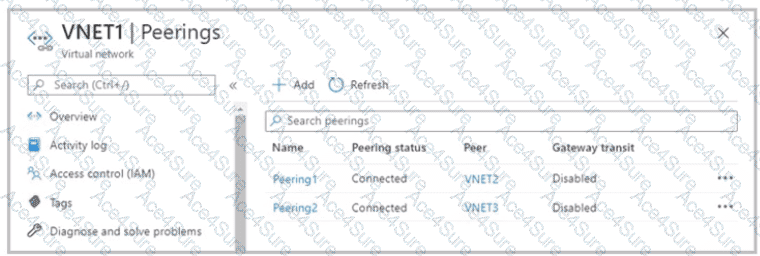
From the exhibit, VNET1 has two peerings configured:
Peering1: VNET1 ↔ VNET2 (Connected)
Peering2: VNET1 ↔ VNET3 (Connected)
For both peerings, Gateway transit is Disabled.
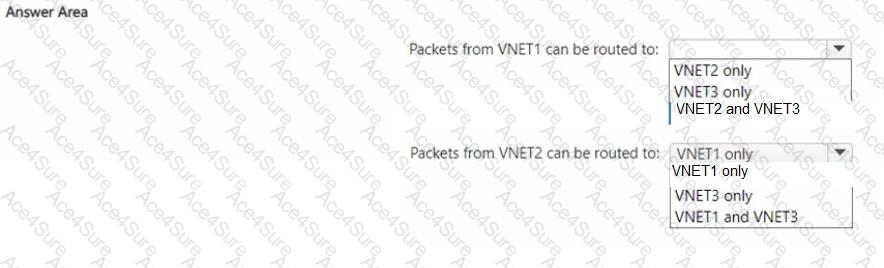
Packets from VNET1
According to Microsoft Azure networking documentation:
VNet peering allows direct routing between peered VNets
A VNet can communicate with all VNets it is directly peered with
Since VNET1 is directly peered with both VNET2 and VNET3, traffic originating in VNET1 can be routed to both networks.
✅ Packets from VNET1 can be routed to VNET2 and VNET3
Packets from VNET2
Azure VNet peering is not transitive. This means:
Even though VNET2 is peered with VNET1
And VNET1 is peered with VNET3
VNET2 does NOT automatically gain access to VNET3
Additionally:
Gateway transit is disabled
No user-defined routing or hub-and-spoke gateway configuration is present
Therefore, VNET2 can only route traffic to its directly peered network, which is VNET1.
✅ Packets from VNET2 can be routed to VNET1 only
Key Microsoft Azure Principles Applied
VNet peering enables direct connectivity only
Peering connections are non-transitive
Gateway transit must be explicitly enabled for transitive routing scenarios
Without gateway transit or NVA routing, VNets cannot route through each other
Final Verified Answer:
Packets from VNET1: ✅ VNET2 and VNET3
Packets from VNET2: ✅ VNET1 only