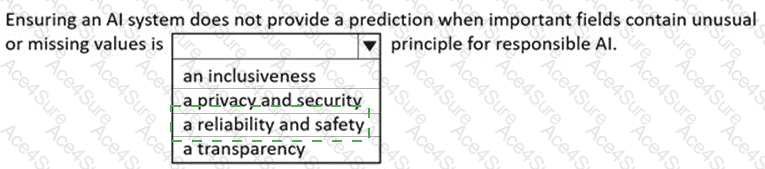
According to Microsoft’s Responsible AI principles, one of the key guiding values is Reliability and Safety, which ensures that AI systems operate consistently, accurately, and safely under all intended conditions. The AI-900 study materials and Microsoft Learn modules explain that an AI system must be trustworthy and dependable, meaning it should not produce results when the input data is incomplete, corrupted, or significantly outside the expected range.
In the given scenario, the AI system avoids providing predictions when important fields contain unusual or missing values. This behavior demonstrates reliability and safety because it prevents the system from making unreliable or potentially harmful decisions based on bad or insufficient data. Microsoft emphasizes that AI systems must undergo extensive validation, testing, and monitoring to ensure stable performance and predictable outcomes, even when data conditions vary.
The other options do not fit this scenario:
Inclusiveness ensures that AI systems are accessible to and usable by all people, regardless of abilities or backgrounds.
Privacy and Security focuses on protecting user data and ensuring it is used responsibly.
Transparency involves making AI decisions explainable and understandable to humans.
Only Reliability and Safety directly address the concept of an AI system refusing to act or returning an error when it cannot make a trustworthy prediction. This principle helps prevent inaccurate or unsafe outputs, maintaining confidence in the system’s integrity.
Therefore, ensuring an AI system does not produce predictions when input data is incomplete or unusual aligns directly with Microsoft’s Reliability and Safety principle for responsible AI.