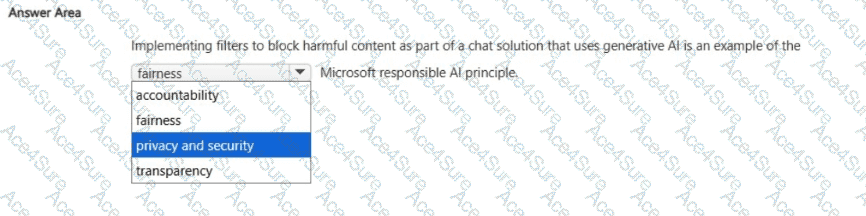
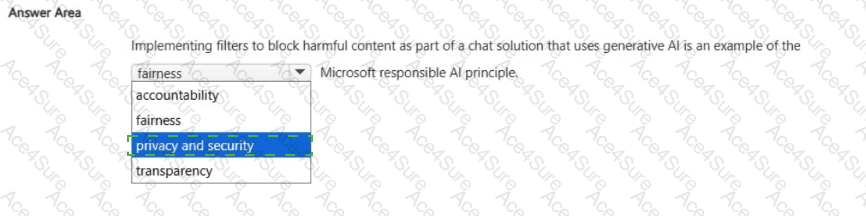
Privacy and security.
According to Microsoft’s Responsible AI Principles, implementing filters to block harmful or inappropriate content in a Generative AI chat solution demonstrates a commitment to the Privacy and Security principle. This principle ensures that AI systems are designed and operated in a way that protects users, their data, and society from harm.
When a chat system uses Generative AI models (like Azure OpenAI’s GPT-based services), there is a risk that the model might produce unsafe, offensive, or sensitive content. Microsoft addresses this through content filters and safety systems, which automatically detect and block violent, hate-based, or sexually explicit outputs. This is part of responsible deployment practices to ensure that user interactions remain safe, private, and compliant with ethical standards.
Implementing these filters aligns with the Privacy and Security principle because it:
Protects users from exposure to harmful or abusive content.
Ensures that conversations are safeguarded against malicious or unsafe use.
Upholds user trust by maintaining a safe digital environment for all participants.
Let’s briefly clarify why the other options are incorrect:
Fairness deals with ensuring unbiased treatment and equitable outcomes in AI decisions.
Transparency focuses on explaining how AI systems make decisions.
Accountability refers to human oversight and responsibility for AI actions.
Thus, content filtering mechanisms are explicitly an example of Privacy and Security, as they protect users and data from harm or misuse while maintaining ethical AI behavior.
Therefore, the verified correct answer is Privacy and security.