Answer Area
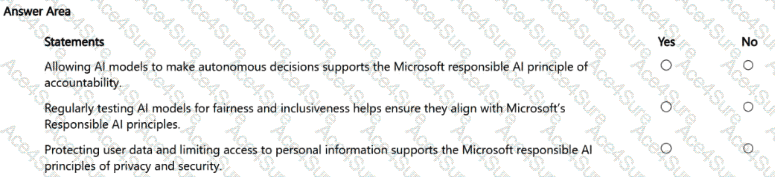
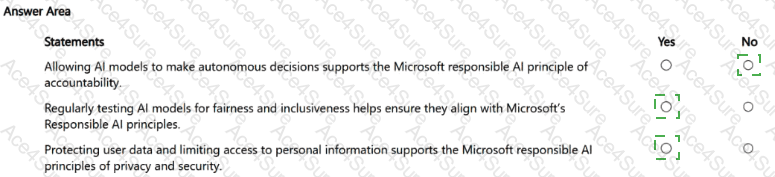
Allowing AI models to make autonomous decisions supports the Microsoft responsible AI principle of accountability. Answer: No
Regularly testing AI models for fairness and inclusiveness helps ensure they align with Microsoft’s Responsible AI principles. Answer: Yes
Protecting user data and limiting access to personal information supports the Microsoft responsible AI principles of privacy and security. Answer: Yes
Microsoft’s Responsible AI principles emphasize that people and organizations must remain accountable for AI systems and their outcomes. Accountability is strengthened by governance, human oversight, clear ownership, auditability, and processes to review and address issues—not by letting models make unchecked autonomous decisions. Therefore, statement 1 is No : increasing autonomy can actually increase risk unless paired with human-in-the-loop controls and clear escalation paths, because accountability requires clear responsibility for decisions and impacts.
Statement 2 is Yes because fairness and inclusiveness are explicitly supported through ongoing evaluation. Regular testing helps detect disparate impact, performance gaps across user groups, and unintended bias introduced by data drift or changes in usage patterns. It’s not a one-time activity; it’s continuous assurance that the system behaves appropriately as conditions change.
Statement 3 is Yes because privacy and security are directly supported by protecting personal/sensitive data, enforcing least privilege access, and implementing controls such as data loss prevention, encryption, access logging, and strong identity governance. Limiting access to personal information reduces exposure and supports compliance obligations while aligning with privacy-by-design and secure-by-design expectations for AI-enabled solutions.