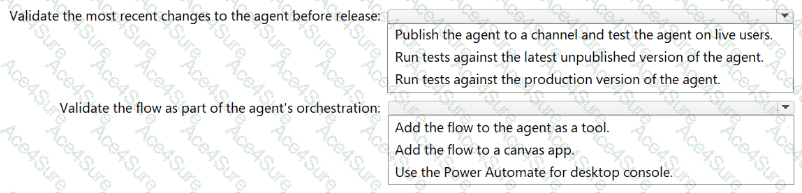
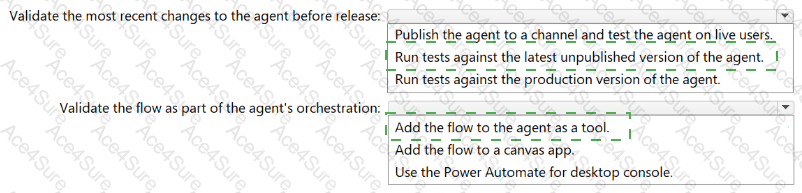
Validate most recent changes → Run tests against the latest unpublished version of the agent; Validate the flow as part of orchestration → Add the flow to the agent as a tool
Why the first selection is correct
The requirement says the company must validate the most recent changes to the agent before the agent is released . That means testing must happen on the newest working version that has not yet been published to productio n.
So the correct recommendation is:
Run tests against the latest unpublished version of the agent
This is the safest and most appropriate pre-release testing pattern because it allows the team to:
verify recent changes before users see them
catch regressions early
validate orchestration logic in a controlled state
reduce production risk
From an AI business solutions perspective, pre-release testing is critical for Copilot agents because even small changes in prompts, tools, orchestration, or data connections can affect:
response quality
workflow behavior
escalation paths
compliance behavior
user trust
Testing unpublished changes ensures that governance and quality assurance happen before release, not after deployment.
Why the second selection is correct
The question also requires that the Power Automate desktop flow be validated as part of the agent ' s orchestration .
That means the flow must participate directly in the agent’s runtime action path. The correct way to do that is:
Add the flow to the agent as a tool
When a flow is added as a tool, the agent can invoke it during its orchestration. This allows test cases to validate not only the conversational layer, but also the actual execution of the flow inside the end-to-end agent behavior.
From an agentic AI design perspective, tools are how agents connect reasoning with action. If the flow is meant to be part of orchestration, it must be exposed to the agent in a way that allows the agent to call it during task execution.
That is the correct enterprise pattern for validating integrated behavior.