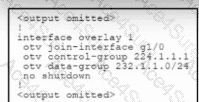
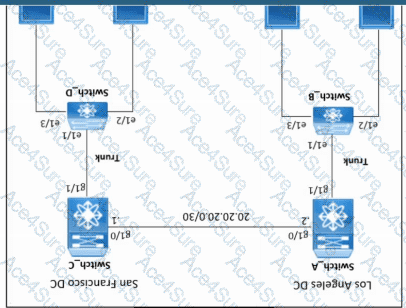
Overlay Transport Virtualization (OTV) allows Layer 2 extension across Layer 3 infrastructures. To operate, OTV requires three fundamental components on the overlay interface:
Join interface – used to reach the OTV control plane over L3 (already configured: otv join-interface g1/0).
Control-group multicast address – for control-plane advertisement (already configured: otv control-group 224.1.1.1).
Extended VLAN list – specifies which VLANs will be transported through the OTV overlay.
The configuration shown in the exhibit includes the join-interface, control-group, and data-group, but it does NOT specify which VLANs should be extended. Without the otv extend-vlan command, OTV will form the overlay interface but will not forward any Layer 2 information, preventing adjacency and MAC distribution between sites.
In OTV, the command required to activate VLANs for transport is:
otv extend-vlan
This enables the VLANs (such as 101–111) to be carried across the OTV overlay, completing the configuration and establishing connectivity.
Why the Other Options Are Incorrect
B. otv isis authentication-type md5
This is optional and only required if ISIS authentication is enabled on both edges. It does not resolve the absence of VLAN extension.
C. otv isis authentication-check
This command enforces authentication verification but does not fix connectivity when VLANs are not extended.
D. otv join-interface vlan 101-111
This is not a valid OTV command. The join-interface must be a routed interface, not a VLAN list.