
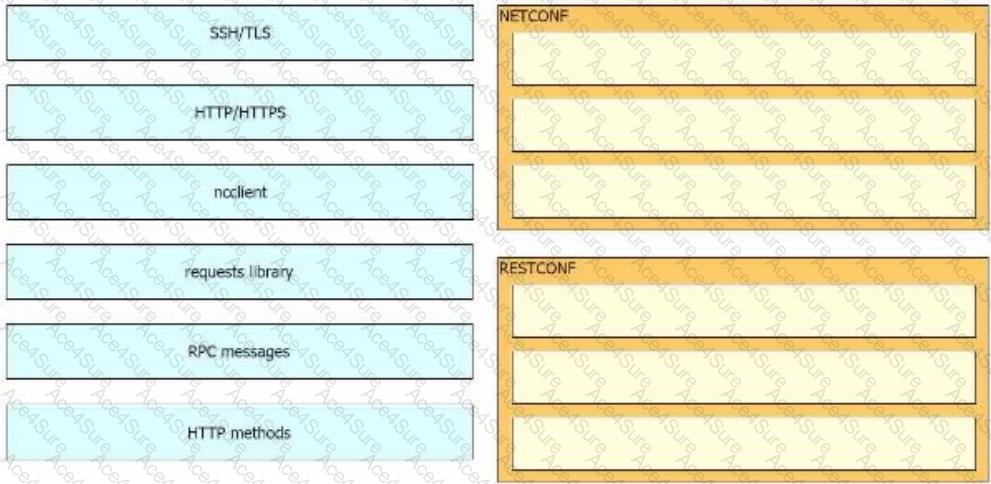
Drag and drop the elements from the left onto the protocols where they are used on the right.
The Answer Is:
Answer:
This question includes an explanation.
Explanation:
The drag-and-drop mapping identifies which elements belong to each model-driven protocol or data-modeling mechanism. Cisco programmability designs distinguish the data model, the encoding, and the transport protocol. YANG defines the structure of configuration and operational data. NETCONF commonly uses XML encoding and provides transactional operations such as get-config, edit-config, lock, and commit-like workflow depending on platform support. RESTCONF exposes YANG-modeled data through HTTP methods and typically uses URI-based resources with XML or JSON encoding. gRPC and gNMI are commonly used for efficient telemetry or operational data streaming, with protocol buffers often used for serialization. The selected mapping follows those protocol boundaries rather than mixing model structure with transport behavior. In design work, this matters because the same network feature can be represented by a YANG model but accessed through different protocols, each with different capabilities, security requirements, and operational semantics. Correctly matching elements to protocols avoids invalid payloads and broken automation workflows. Reference topics: YANG, NETCONF, RESTCONF, gRPC, gNMI, XML and JSON encoding, model-driven telemetry.
300-420 PDF/Engine
Printable Format
Value of Money
100% Pass Assurance
Verified Answers
Researched by Industry Experts
Based on Real Exams Scenarios
100% Real Questions
Get 65% Discount on All Products,
Use Coupon: "ac4s65"

