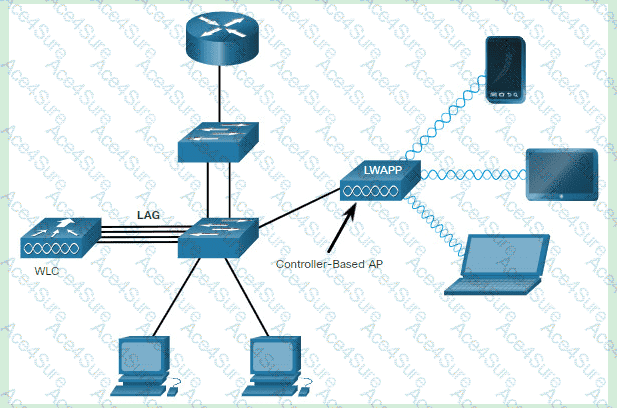
register with a single access point that controls traffic between wired and wireless endpoints.
B.
use SSIDs to distinguish between wireless clients.
C.
send LWAPP packets to access points.
D.
monitor activity on wireless and wired LANs
The Answer Is:
C
This question includes an explanation.
Explanation:
A Wireless LAN Controller manages lightweight access points by exchanging control traffic with them. Older Cisco controller deployments used LWAPP, while modern deployments use CAPWAP, but the intent of the answer is the controller-to-lightweight-AP communication function. The WLC is not an AP itself and does not register with a single AP that controls the network. SSIDs identify WLANs for clients, but simply using SSIDs is not the defining WLC function. Monitoring wired LAN activity is not the best description either. Cisco CCNA 200-301 v1.1 Network Access expects candidates to understand the controller-based wireless model: lightweight APs depend on the controller for centralized management, configuration, and policy. The controller sends and receives control-plane messages with APs so wireless services can be coordinated at scale. Within the available choices, sending LWAPP packets to access points is the function that identifies a WLC.
200-301 PDF/Engine
Printable Format
Value of Money
100% Pass Assurance
Verified Answers
Researched by Industry Experts
Based on Real Exams Scenarios
100% Real Questions
Get 65% Discount on All Products,
Use Coupon: "ac4s65"