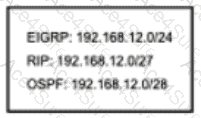
How does the router manage traffic to 192.168.12.16?
A.
It selects the RIP route because it has the longest prefix inclusive of the destination address.
B.
It chooses the OSPF route because it has the longest prefix inclusive of the destination address.
C.
it load-balances traffic between all three routes
D.
It chooses the EIGRP route because it has the lowest administrative distance
The Answer Is:
A
This question includes an explanation.
Explanation:
Routers choose the route with the longest matching prefix before comparing protocol preference for equally specific routes. If the RIP entry contains the longest prefix that includes destination 192.168.12.16, that route is selected even though RIP has a worse administrative distance than OSPF or EIGRP. Administrative distance only becomes the deciding factor when competing routes describe the same prefix length. Cisco CCNA 200-301 v1.1 IP Connectivity repeatedly tests this rule because it is fundamental to forwarding decisions. The router does not load-balance among routes simply because multiple protocols know related networks. It also does not choose EIGRP solely because EIGRP has a lower administrative distance when another route is more specific. The forwarding lookup starts with the destination IP address and finds the most specific matching prefix in the routing table. In this exhibit, the RIP route is the longest prefix inclusive of 192.168.12.16, so A describes the router behavior correctly.
200-301 PDF/Engine
Printable Format
Value of Money
100% Pass Assurance
Verified Answers
Researched by Industry Experts
Based on Real Exams Scenarios
100% Real Questions
Get 75% Discount on All Products,
Use Coupon: "ac75sure"